
# Difference Between HDPE and UHMWPE Ground Protection Mats
Ground protection mats are essential in construction, landscaping, and heavy equipment operations to prevent soil damage and provide stable access routes. Among the most commonly used materials are **HDPE (High-Density Polyethylene)** and **UHMWPE (Ultra-High Molecular Weight Polyethylene)**. While both belong to the polyethylene family, their properties, performance, and applications differ significantly.
—
## What Are HDPE Ground Protection Mats?
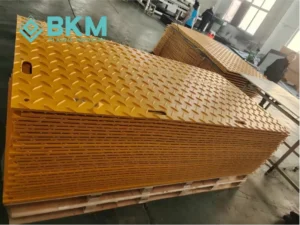
HDPE is a widely used thermoplastic known for its balance of strength, durability, and cost-effectiveness. HDPE ground protection mats are commonly used in temporary access solutions due to their affordability and ease of handling.
### Key Features of HDPE Mats
– **Moderate Strength and Durability**: HDPE provides reliable performance under light to medium loads.
– **Cost-Effective**: It is significantly cheaper than UHMWPE, making it ideal for budget-conscious projects.
– **Lightweight**: Easier to transport and install manually.
– **Chemical Resistance**: Resistant to many acids and chemicals.
– **Textured Surface**: Often designed with anti-slip patterns for improved safety.
### Common Applications
HDPE mats are typically used in:
– Construction sites with light to medium traffic
– Temporary roadways
– Landscaping and turf protection
– Pedestrian walkways
—
## What Are UHMWPE Ground Protection Mats?

UHMWPE is an advanced engineering plastic with extremely long molecular chains, giving it superior strength and performance characteristics compared to HDPE.
### Key Features of UHMWPE Mats
– **Exceptional Impact Resistance**: One of the highest impact strengths among thermoplastics.
– **Ultra-High Wear Resistance**: Ideal for harsh environments with constant heavy use.
– **Low Friction Surface**: Allows heavy machinery to move smoothly.
– **Extreme Durability**: Maintains integrity under heavy loads and repeated stress.
– **Temperature Resistance**: Performs well in both very low and moderately high temperatures.
### Common Applications
UHMWPE mats are best suited for:
– Heavy construction and infrastructure projects
– Oil & gas operations
– Mining sites
– Crane and heavy equipment access roads
– Wet, muddy, or unstable ground conditions
—
## Key Differences Between HDPE and UHMWPE Mats

### 1. Molecular Structure
– **HDPE**: Shorter molecular chains → moderate strength
– **UHMWPE**: Extremely long chains → superior strength and durability
### 2. Load-Bearing Capacity
– **HDPE**: Suitable for light to medium loads
– **UHMWPE**: Designed for heavy-duty applications and extreme loads
### 3. Wear and Abrasion Resistance
– **HDPE**: Good resistance, but wears faster under heavy use
– **UHMWPE**: Outstanding resistance, ideal for high-friction environments
### 4. Cost
– **HDPE**: More affordable
– **UHMWPE**: Higher initial cost, but longer lifespan
### 5. Weight and Handling
– **HDPE**: Lighter and easier to handle
– **UHMWPE**: Slightly heavier but still manageable compared to steel alternatives
### 6. Lifespan
– **HDPE**: Suitable for short-term or moderate use
– **UHMWPE**: Long-term solution with minimal wear
—
## Which One Should You Choose?
The choice between HDPE and UHMWPE ground protection mats depends on your specific project requirements:
– Choose **HDPE mats** if you need a **budget-friendly, lightweight solution** for temporary or moderate-use applications.
– Choose **UHMWPE mats** if your project involves **heavy machinery, harsh conditions, or long-term use**, where durability and performance are critical.
—
## Conclusion
Both HDPE and UHMWPE ground protection mats play important roles in protecting surfaces and improving site accessibility. HDPE offers a practical and economical option for general use, while UHMWPE delivers unmatched strength and durability for demanding environments. Understanding these differences will help you select the right material for your project, ensuring safety, efficiency, and long-term value.


Comments
mike
Mar.5.2026good good
rose
Aug.5.2026good goodgood goodgood goodgood good