
 English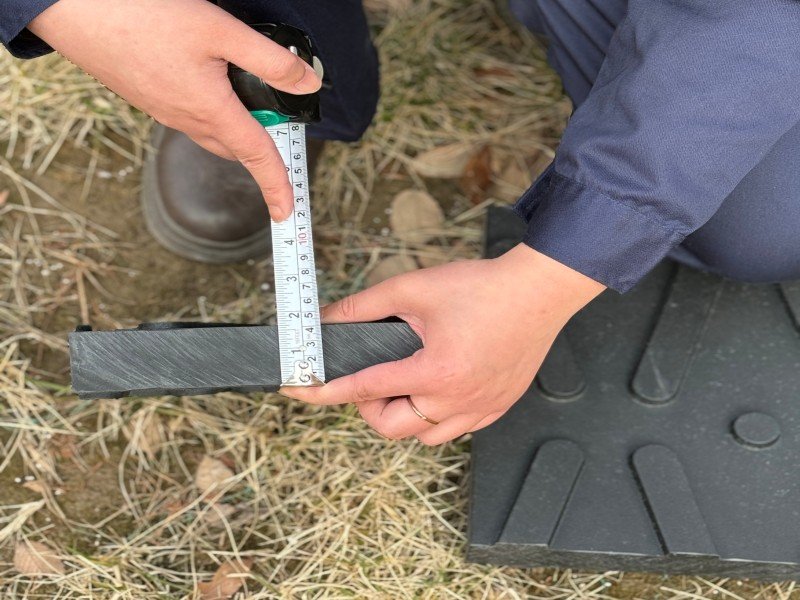
450 Mats for a 1,500 ft Temporary Road: How BKM Supported a Mississippi Riverbank Earthwork Project
Project Overview
The customer was working on a riverbank earthwork project near the Mississippi River. The job required the movement of about 300,000 cubic meters of soil.
Dump trucks, excavators, forklifts, and other site vehicles had to move back and forth across soft riverbank ground every day. The original plan was to build a temporary haul road with crushed stone, but the project schedule was tight and the ground condition made that plan expensive and slow.
The site had several problems at the same time:
* The riverbank soil was soft, muddy, and unstable after rain;
* Trucks and excavators could get stuck and slow down the earthmoving schedule;
* A crushed-stone road required large material volume, installation work, and later cleanup;
* Steel plates were heavy, expensive to transport, and slower to install;
* The permanent road was not ready yet, and the ground had to be restored after the project.
For this project, the customer did not need a permanent road. He needed a temporary access route strong enough for heavy site traffic, but still removable after the earthwork was completed.
Our Solution
What BKM Recommended and Did
BKM recommended standard HDPE ground protection mats instead of a custom mat or a crushed-stone temporary road.
Recommended specification:
* Quantity: 450 mats
* Material: HDPE
* Size: 4 ft × 8 ft / 1220 × 2440 mm
* Thickness: 38 mm
* Weight: about 116 kg per mat
* Effective area: 2.98 m² / about 32 sq.ft per mat
* Total coverage: about 1,341 m² / 14,400 sq.ft
* Dynamic load: 80 tons
* Static load: 120 tons
* Surface: diamond tread
* Color: black
* Design: hand holes and connector holes
* Accessories: 2-way and 4-way connectors
* Use: soft-ground haul road, dump truck access, excavator access, temporary working areas
The customer needed about 1,500 ft of temporary access road. With 450 mats, BKM helped plan a route that could support the main haul path while leaving extra mats for entrances, turning areas, and equipment stopping points.
If two 4 ft × 8 ft mats are laid side by side, they create an access lane about 8 ft wide. For a 1,500 ft route, about 375 mats can form the main road. The remaining mats can be used where pressure is higher: muddy entrances, truck turning areas, loading points, and short work platforms near excavation zones.
BKM recommended the 38 mm thickness because this was not a light landscaping project. The site had repeated truck and machinery movement on soft ground. The mat needed enough stiffness and load capacity to spread vehicle pressure, but it also had to remain removable after the project.
The diamond tread surface helped improve tire grip on wet and muddy ground. On a riverbank site, smooth boards would not provide enough traction for high-frequency vehicle movement.
BKM also supplied connectors with the mats. This was important for a long temporary road. When dump trucks turn, brake, or pass over soft sections, loose mats can shift, separate, or lift at the edges. The connectors helped lock the mats together, reduce movement, keep the route more stable, and make the road safer for repeated traffic.
During production, BKM kept the customer updated with product photos, testing videos, production videos, packing videos, and loading videos. The customer could check the mat surface, thickness, connector holes, packing condition, and shipment progress before delivery.
Result and Takeaway
After the mats arrived, the customer used them to build a temporary HDPE access road across the soft riverbank work area.
The mats helped spread vehicle pressure over the muddy ground and kept dump trucks and excavators moving through the main haul route. Compared with a crushed-stone road, the HDPE mat system was faster to deploy, cleaner to remove, and easier to reuse after the project.
The connected mat road also reduced the risk of loose boards shifting under heavy traffic. This helped the site maintain a more stable driving surface during soil transport, especially at entrances, turning points, and loading areas.
After the earthwork was completed, the mats could be removed, cleaned, stacked, and transferred to future projects instead of being left in the ground like crushed stone.
For riverbank and soft-ground earthwork projects, the key decision is not only mat thickness. The route length, road width, vehicle type, turning points, connection method, and post-project recovery all matter.
In this project, the 4 ft × 8 ft, 38 mm HDPE mat was a practical choice because it created a removable haul road for heavy site traffic, reduced dependence on crushed stone, and allowed the contractor to reuse the access system after the job was finished.