
 English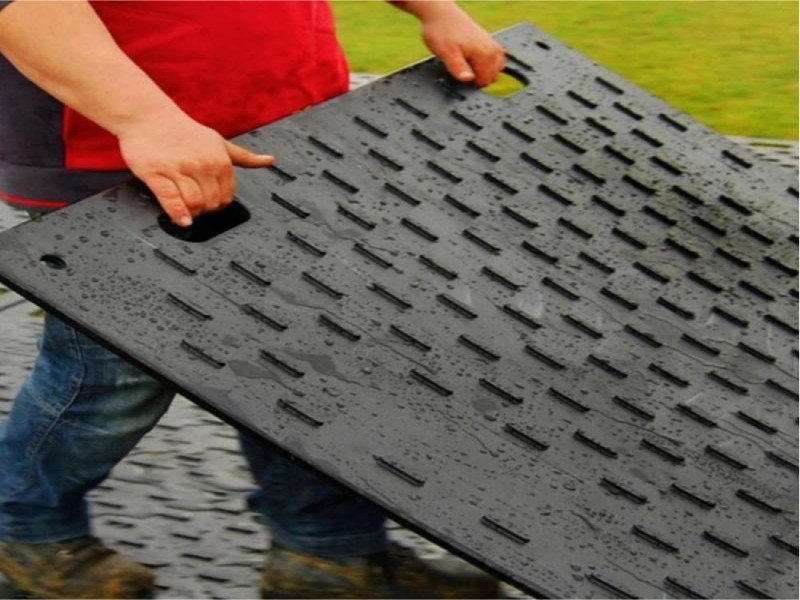
A Removable HDPE Access Road Helped a Forestry Contractor Keep the Project Moving
Project Overview
The customer was a forestry and outdoor construction contractor in the United States. His project was inside a forest area, where the ground was soft, uneven, and difficult to access after rain.
This was not a jobsite where one fixed road could solve everything.
As the work moved deeper into the forest, the access route also had to change. Trucks and small machines needed to enter different sections of the site, but driving directly over the wet ground could quickly create deep ruts and make the next day’s access even harder.
The customer was not sure what kind of mat should be used for this type of ground.
He needed to know:
* What size would work on uneven forest ground?
* What thickness would be enough without making the mats too hard to move?
* What surface pattern would help vehicles keep traction after rain?
* Could the mats be recovered and moved to the next work area?
* Would connectors be necessary?
For this project, the goal was not to build a permanent road. The customer needed a temporary access system that could move with the job.
Our Solution
Why BKM Recommended 4 ft × 8 ft HDPE Mats
After reviewing the site condition and vehicle use, BKM recommended a standard HDPE ground protection mat with two-sided tread and connectors.
Recommended specification:
* Material: HDPE
* Size: 4 ft × 8 ft / 1220 × 2440 mm
* Base thickness: 1/2 inch / 12.7 mm
* Thickness with two-sided texture: 22.7 mm
* Weight: about 41 kg per mat
* Effective area: 2.98 m² / about 32 sq.ft per mat
* Dynamic load: 20–30 tons
* Static load: 50 tons
* Surface: double-sided anti-slip tread
* Design: hand holes and connector holes
* Accessories: 2-way and 4-way connectors
* Use: forest access, soft ground protection, temporary vehicle routes, movable work areas
BKM recommended 4 ft × 8 ft because it gave the customer enough coverage for vehicle access, while still being practical to move from one forest section to another.
One mat covers about 32 sq.ft.
Every 100 mats can protect about 3,200 sq.ft / 298 m² of ground.
If laid as a single 1.22m-wide route, 100 mats can create about 244m of temporary pathway. If laid two mats wide for a 2.44m vehicle access lane, 100 mats can create about 122m of protected road.
The 1/2 inch base thickness was also important. A thicker heavy-duty mat might work for larger machines, but it would be harder to relocate frequently in a changing forest site. This specification gave the contractor a better balance between ground protection, vehicle access, handling, and reuse.
The two-sided tread helped with both sides of the problem. The top surface gave tires better grip on wet or muddy ground. The bottom texture helped the mat sit more securely on uneven soil instead of sliding like a smooth board.
BKM also recommended connectors because forest ground is rarely flat. When vehicles turn, brake, or pass over uneven areas, loose mats can shift. With 2-way and 4-way connectors, the customer could build a more stable temporary road and then move sections of the road as the work area changed.
What Made the Customer Feel Secure
The customer was not only buying mats. He needed confidence that the product would be made correctly and delivered on time.
During the order process, BKM kept sending updates:
* production videos;
* product testing videos;
* surface and hole inspection videos;
* packing videos;
* loading and shipment videos.
These videos helped the customer see the product before it arrived. He could check the mat surface, thickness, hand holes, connector holes, and packing condition during the process instead of waiting blindly for delivery.
For an overseas buyer, this kind of visibility matters. It reduces uncertainty and makes the purchase feel more controlled.
The Mats Moved with the Project
After the mats arrived, the customer used them to create a removable access route inside the forest site.
The mats reduced direct vehicle pressure on the soft ground and helped vehicles reach the work area after rain. Instead of building a permanent road or repeatedly repairing rutted ground, the contractor could move the mats as the project advanced.
When the project ended, the customer recovered the mats and transferred them to the next jobsite.
That was the real cost saving.
The mats were not left behind like gravel or temporary fill material. They became reusable access equipment for future forestry and outdoor construction projects.
For forestry contractors, the useful lesson is this:
Do not choose ground protection mats only by thickness. In changing forest worksites, size, weight, surface grip, connectors, and relocation efficiency all matter.
A 4 ft × 8 ft HDPE mat with two-sided tread is a practical choice when the site is soft, uneven, and temporary. It can reduce direct ground damage, improve access after rain, and move with the project instead of becoming a one-time site cost.