
Heavy Duty Ground Protection Mats
BKM manufactures two heavy-duty systems for demanding sites: 38 mm solid composite UHMWPE road mats and 102 mm large-format hollow-core polyethylene roadway panels. Both are built for temporary access roads, heavy equipment routes, work pads and all-weather construction access.

Heavy Duty Ground Protection Mats for Temporary Roads and Heavy Equipment
Heavy duty ground protection mats create a stable, reusable running surface where trucks, excavators, cranes and tracked equipment must cross mud, soft soil or sensitive ground. The panels spread traffic loads over a wider area, keep vehicles on a defined route and reduce the deep rutting that increases recovery time and site reinstatement costs.
BKM offers a solid plate system for configurable tracks and pads, plus a deep hollow-core composite system for connected full-width roadways. The correct choice depends on the ground, axle or track load, number of passes, turning behavior and required road layout.

Two Heavy-Duty Access Mat Systems for Different Ground Conditions
Choose the panel structure around the site and roadway layout—not from a single tonnage number.

Solid Composite UHMWPE Heavy Duty Road Mats
BKM-01 and BKM-02 are one-piece composite UHMWPE road mats made for tracked vehicles and heavy construction traffic. Both use a 38 mm solid body and measure 48 mm overall with the molded traction texture, with a reference load capacity of 120 tonnes under the stated product conditions.
BKM-01 measures 3000 × 2500 mm and weighs 293 kg; BKM-02 measures 4000 × 2000 mm and weighs 312 kg. Their different footprints allow the road layout, handling plan and container utilization to be matched to the project.
- Composite UHMWPE construction
- 38 mm body thickness
- 48 mm overall with texture
- 120-tonne reference capacity
- Black standard color
- 2-way and 4-way connectors

Hollow-Core Heavy Duty Composite Roadway Mats
BKM hollow-core composite mats use a deep cellular body with internal reinforcement. The structural section is designed to increase panel stiffness without using a completely solid block at the same overall depth, while large-format coverage reduces the number of joints across a temporary road.
Each panel has transport dimensions of 4350 × 2430 mm and provides a usable installed surface of 4160 × 2240 mm, equal to 9.31 m². Eight mechanical connection bolts secure each panel within the roadway layout.
- Polyethylene construction
- 102 mm total thickness
- 465 kg panel weight
- 9.31 m² usable coverage
- 8 connection bolts per panel
- Beige standard color
Solid Composite UHMWPE Access Mats in Greater Detail
The confirmed solid range comprises two composite UHMWPE formats with the same 38 mm body, 48 mm textured overall thickness and 120-tonne reference load capacity. These 293–312 kg panels require mechanical handling and are intended for industrial routes—not lightweight hand-laid lawn protection.
Each 293 kg panel covers a nominal 7.50 m². Reference loading is 26 panels in a 20GP or 72 panels in a 40HQ, equal to 195 m² or 540 m² of nominal panel area.
Each 312 kg panel covers a nominal 8.00 m². Reference loading is 43 panels in a 20GP or 87 panels in a 40HQ, equal to 344 m² or 696 m² of nominal panel area.
The specification distinguishes the structural body thickness from the overall thickness measured across the traction texture, preventing the two figures from being confused during comparison and inspection.
The material and molded surface are specified for tracked-vehicle applications. Black is standard; custom colors are available subject to minimum order quantity.
Large Hollow-Core Composite Mats as a Connected Road System
The hollow-core range uses a 102 mm structural depth and internal reinforcement to create a large-format polyethylene roadway panel. Each 465 kg panel is installed mechanically and joined with eight connection bolts.
Internal ribs support the upper and lower skins and help transfer rolling loads through the panel footprint without using a fully solid block at the same overall depth.
The specified bolt quantity must be included in roadway planning, spare-accessory quantities and installation checks so adjacent panels remain secured throughout use.
The selected BKM model is reviewed for shell construction and sealing requirements. Polymer panels do not rot like timber and can be pressure-cleaned, inspected and prepared for reuse.
Forklifts, excavators or cranes position each panel. The 4350 × 2430 mm transport footprint becomes a 4160 × 2240 mm usable surface in the installed layout.
Heavy Duty Ground Protection Mat Specifications
Reference configurations for BKM solid and hollow-core heavy equipment access mats. Final drawings and ratings are confirmed for the selected model.

Solid Heavy Duty Road Mat Specifications
| Material | Composite UHMWPE (Ultra-High-Molecular-Weight Polyethylene) |
|---|---|
| Panel construction | One-piece solid composite polymer plate |
| Confirmed models | BKM-01 and BKM-02 |
| Body thickness | 38 mm (1.5 in) |
| Overall thickness with texture | 48 mm (1.89 in) |
| Reference load capacity | 120 tonnes |
| Surface | Molded heavy-vehicle traction texture |
| Connection | 2-way, 4-way or project-specific mechanical connectors |
| Installation | Forklift, excavator, crane or suitable lifting attachment |
| Color | Black standard; custom colors subject to minimum order quantity |
| Container quantity | BKM-01: 26 pcs / 20GP or 72 pcs / 40HQ; BKM-02: 43 pcs / 20GP or 87 pcs / 40HQ |
| Best suited to | Tracked vehicles, heavy equipment routes, construction roads and work pads |
Hollow-Core Composite Access Mat Specifications
| Product type | BKM large-format hollow-core polyethylene roadway mat |
|---|---|
| Material | Polyethylene |
| Panel construction | Hollow-core body with reinforced internal load-spreading structure |
| Transport dimensions | 4350 × 2430 mm (14.27 × 7.97 ft) |
| Usable installed dimensions | 4160 × 2240 mm (13.65 × 7.35 ft) |
| Usable coverage | 9.31 m² (approx. 100.2 ft²) per panel |
| Total thickness | 102 mm (4 in) |
| Panel weight | 465 kg (approx. 1,025 lb) |
| Connection | 8 mechanical connection bolts per panel |
| Color | Beige |
| Lifting method | Forklift or excavator/crane with an approved lifting attachment |
| Best suited to | Full-width temporary roads, work platforms, wetlands and soft ground |
Transport dimensions and usable installed dimensions are listed separately because connected roadway coverage is smaller than the panel's maximum transport footprint. Load capacity and container quantity for the hollow-core model are confirmed separately from project and loading requirements.
Solid Heavy Duty Mat Specifications
The figures below come from BKM's product specification. The 120-tonne load capacity is a model reference and must still be checked against subgrade support, load footprint, vehicle movement and the installed layout.
| Model | Panel Size | Body / Overall Thickness | Weight | Load Capacity | Panel Area | 20GP | 40HQ |
|---|---|---|---|---|---|---|---|
| BKM-01 | 3000 × 2500 mm (9.8 × 8.2 ft) | 38 mm body / 48 mm with texture | 293 kg (646 lb) | 120 tonnes | 7.50 m² | 26 pcs / 195 m² | 72 pcs / 540 m² |
| BKM-02 | 4000 × 2000 mm (13.1 × 6.5 ft) | 38 mm body / 48 mm with texture | 312 kg (687 lb) | 120 tonnes | 8.00 m² | 43 pcs / 344 m² | 87 pcs / 696 m² |
Need a non-standard panel size or thickness? Tell us your requirements and our team will respond within one business day.
Solid vs Hollow-Core Heavy Duty Composite Mats
Both systems create reusable heavy equipment access, but they solve different route and ground-condition requirements.


| Decision Factor | Solid Heavy Duty Mat | Hollow-Core Composite Mat |
|---|---|---|
| Construction | Solid composite UHMWPE plate | Polyethylene hollow-core body with reinforced internal structure |
| Format | 3000 × 2500 mm or 4000 × 2000 mm | 4350 × 2430 mm transport size; 4160 × 2240 mm usable size |
| Road layout | Wheel tracks, lanes, turning zones and pads | Continuous full-width roads and platforms |
| Connection | External 2-way / 4-way links | 8 mechanical connection bolts per panel |
| Ground conditions | Prepared, firm or moderately soft ground | Soft, wet, muddy and variable subgrades |
| Main advantage | 120-tonne reference load capacity with documented container quantities | 9.31 m² usable coverage from each connected panel |
| Handling | Mechanical handling; 293–312 kg per panel | Mechanical handling; 465 kg per panel |
The project needs defined wheel tracks, prepared-to-moderately-soft ground, localized turning areas or one of the confirmed 3000 × 2500 mm and 4000 × 2000 mm solid UHMWPE formats.
The priority is a large-format, full-width continuous road over soft, wet or variable ground with repeated heavy rolling traffic and controlled seams.
A hollow-core main route needs solid custom transition panels, expanded work zones or project-specific pieces at entrances, intersections and equipment areas.
How Heavy Duty Road Mats Carry Equipment Traffic
A temporary roadway works by spreading tire or track pressure through the panel into a larger area of supporting ground. Gross vehicle weight is only the starting point: axle load, contact area, turning, braking, repeated passes and soil strength determine how the system behaves.
Multiple axles do not load every panel equally. BKM reviews the heaviest axle group and tire contact footprint.
Track width spreads vertical load, while grousers and counter-rotation can introduce high local wear and lateral stress.
Steering, braking and acceleration create shear forces that require wider layouts and secure connections.
A single controlled pass differs from hundreds of daily passes or long-term parking on the same area.
Load Path Through a Temporary Road
The mat distributes pressure; it does not manufacture bearing capacity or safely bridge an unsupported trench. Model ratings must always be read with the installation and subgrade assumptions.
Heavy Duty Temporary Roadway Layouts
Quantity planning starts with the whole route: usable connected coverage, traffic direction, turns, passing points, work areas, transitions and spare panels.

Single-Lane Temporary Access Roads
A full-width one-way route keeps wheels or tracks within the connected mat surface. Road width is set from vehicle width, steering movement and a safe edge allowance—not from panel width alone.
Straight routes · controlled direction · defined entryTwo-Way Roads and Passing Bays
High-traffic sites may need a wider two-way road or planned passing bays. Extra coverage is allowed at waiting points so stopped vehicles do not load an unsupported shoulder.
Two-way traffic · passing areas · waiting zonesHeavy Equipment Work Platforms
Panels can expand from a road into equipment staging, laydown, maintenance or general working areas. Platform geometry follows machine movement and the location of concentrated loads.
Staging · laydown · maintenance · general work padsTransitions, Turns and Road Ends
Entry ramps, braking areas, intersections and tight turns receive more shear force than straight travel. These zones need additional width, secure connections and more frequent inspection.
Entry ramps · intersections · braking · turning


Interlocking Systems for Heavy Duty Temporary Road Mats
Connectors keep the temporary road aligned as vehicles cross panel seams. BKM matches the connection method to the panel structure and the width of the required roadway or work platform.
2-Way Connectors for Straight Access Roads
Join solid road mats edge to edge along a linear wheel path, equipment track or single lane.
4-Way Connectors for Work Pads and Wide Roads
Secure four panel corners where the layout expands into passing areas, turning zones or equipment platforms.
Eight-Bolt Connections for Hollow-Core Panels
Each hollow-core panel uses eight mechanical connection bolts. The specified quantity must be installed and checked to control gapping, drifting and panel movement.
See the Road Mat Connection System in Action
Watch how heavy duty road mats are aligned, connected and securely locked with the dedicated installation tool, then unlocked and removed for dismantling and storage.
Ground Protection Mats for Heavy Equipment Applications
Industrial access solutions for construction, energy, utilities, oilfield, mining and environmentally sensitive sites.

Construction Road Mats for Heavy Equipment
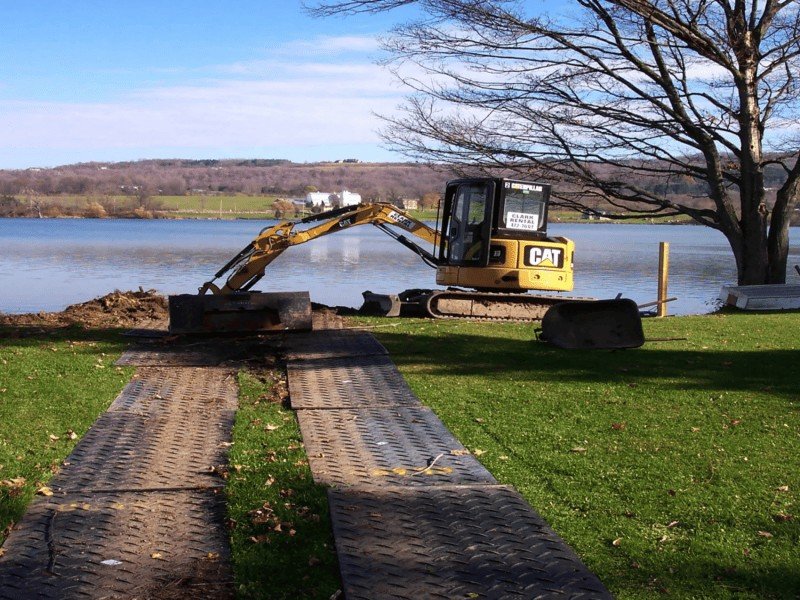
Create defined routes for excavators, dump trucks, concrete mixers and delivery vehicles while reducing rutting and imported stone requirements.

Temporary Access Mats for Utilities
Maintain all-weather access to transmission lines, substations, wind farms, cable corridors and remote maintenance locations.

Composite Road Mats for Oilfield and Pipeline Sites
Build temporary haul roads, drill-site access, pipeline corridors, staging zones and connected working surfaces over difficult terrain.
Heavy Equipment Mats for Mining and Quarries
Provide repeatable plant routes and protected work areas for tracked machinery, service vehicles and high-frequency industrial traffic.

Wetland and Soft-Ground Access Mats
Distribute rolling loads across muddy, marshy or waterlogged ground while reducing deep ruts and the area requiring reinstatement.

Renewable Energy and Wind Farm Access
Build temporary routes to turbine foundations, solar sites and remote energy projects for delivery vehicles, lifting equipment and maintenance fleets.

Temporary Access Roads for Environmental Remediation
Build connected temporary roadways for repeated excavator, dump truck and service vehicle traffic across soft, sandy or disturbed ground during soil cleanup and site restoration projects.
Emergency and Disaster Access Roads
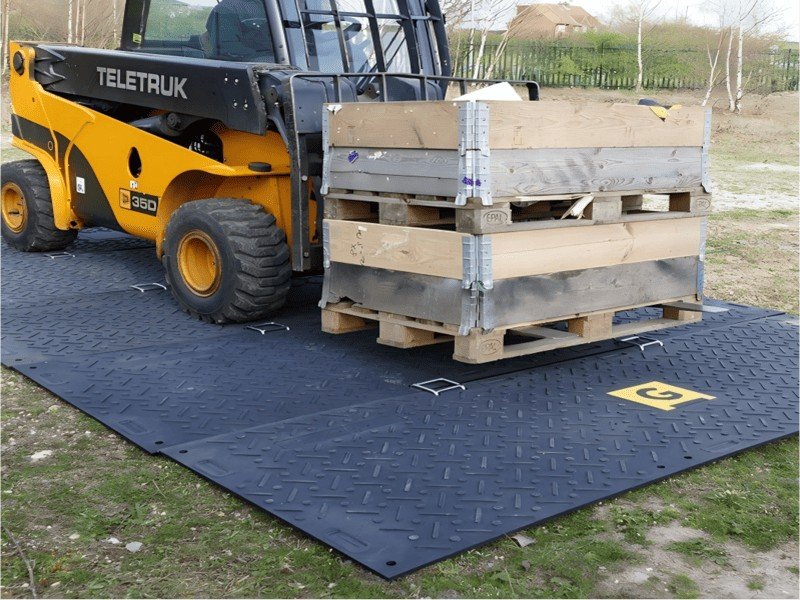
Restore controlled vehicle access across damaged, saturated or unprepared ground for response equipment, temporary utilities and recovery logistics.

Forestry and Logging Access Roads
Create temporary access routes for forestry machinery, logging trucks and maintenance vehicles across muddy, uneven or sensitive ground.
Heavy Duty Access Mats for Mud, Sand, Wetlands and Uneven Ground
Ground description changes the panel recommendation, base preparation, supported road width and inspection plan. The full-width site image remains fixed while the conditions below move across it.
Mud and Saturated Soil
Hollow-core first evaluationUse a connected full-width route, control drainage and assess whether geotextile or a prepared layer is needed beneath the panels.
Sand and Loose Fill
Wide solid or hollow-core layoutIncrease the supported width and limit edge loading, sharp steering and sudden braking that can displace loose material.
Wetlands and Marshes
Hollow-core continuous roadwayPlan access, environmental separation, retrieval and cleaning before installation; follow all project-specific environmental requirements.
Grass and Sensitive Surfaces
Select by load and durationKeep vehicles on the planned route and consider heat, moisture, duration and recovery requirements as well as the machine weight.
Frozen Ground and Snow
Impact-resistant formulationReview low-temperature material performance, traction, hidden voids and the change in bearing condition when the ground thaws.
Uneven or Prepared Subgrade
Solid mats often suitableRemove sharp projections, fill major depressions and prevent panels from rocking across unsupported high and low points.
Slopes and Crossfalls
Project-specific assessmentEvaluate lateral movement, anchoring, runoff, braking and rollover risk. Mats do not make an unsuitable slope safe by themselves.
How to Install Heavy Duty Temporary Road Mats
Both systems on this page require planned handling. The construction background remains fixed while the nine installation stages scroll through the foreground.
Survey the route
Record soil condition, drainage, slope, soft spots, underground constraints and environmental limits.
Plan traffic and layout
Define travel direction, road width, turns, passing bays, work areas, entrances and exits.
Prepare the surface
Remove sharp debris and fill major voids; add geotextile, drainage or a prepared layer when required.
Set the first panel row
Square and align the starting row because every following seam follows this reference.
Connect each panel
Install the specified 2-way or 4-way links for solid mats, or all eight connection bolts required for each hollow-core panel, before opening the route.
Build transitions and turns
Widen and reinforce entrances, road ends, intersections, braking zones and tight turning areas.
Complete a test pass
Use a low-speed controlled pass and check rocking, seam movement, edge support and traction.
Inspect during operation
Adjust the inspection frequency to rainfall, traffic volume, turning, braking and ground movement.
Remove, clean and stack
Lift with approved points, clear connectors, wash the panels and stack them evenly for the next project.
Cleaning, Inspection, Storage and Reuse
Reusability depends on what happens after the road closes. Cleaning the tread and joints, identifying damage and stacking panels on even support protects the next installation and the long-term return on the mat fleet.
Remove mud, aggregate and organic material from tread, overlaps, connector holes and lifting points.
Check cracking, permanent deformation, deep wear, damaged edges, distorted holes and loose internal components.
Clean and count links, bolts and anchors; replace bent, cracked or excessively worn hardware before redeployment.
Support the panel stack evenly and keep damaged or unverified mats separated from ready-to-use inventory.
Use the approved lifting points and equipment; avoid dropping panels or dragging connection edges across hard ground.
Project markings, serial identification and inspection records help dealers and contractors manage reuse between sites.
How to Select Heavy Duty Construction Mats
Total vehicle weight alone is not enough to specify a temporary road. Send these six project inputs so BKM can compare the solid and hollow-core systems, calculate the quantity and recommend the connection layout.
Ground condition
Soil type, bearing capacity, saturation, drainage, slope and known soft spots.
Vehicle and equipment loads
Gross weight, axle load, tire pressure, track width and contact area.
Traffic pattern
Passes per day, speed, turning, braking, reversing and project duration.
Required layout
Road length and width, corners, passing bays, platforms and entry points.
Installation resources
Available forklift, crane or excavator and any transport or lifting limits.
Project destination
Delivery port, unloading plan, schedule, quantity and documentation needs.
Custom Heavy Duty Composite Mats from BKM
BKM develops the panel, connection and packing plan around the target market, equipment fleet and installation method.

Custom length, width, plate thickness, overlap geometry and usable coverage for the required road module.
Material and additive package for the solid models are confirmed around impact, wear, climate and project requirements.
Single or double-sided tread, vehicle grip profile and non-aggressive surface options.
2-way or 4-way links for solid mats, eight-bolt connection layout for hollow-core panels and project-specific connector positioning.
Project color, molded logo, serial marking and traceability options for rental or dealer fleets.
Dimensional checks, connection fit, agreed test documents, stack plan, accessories and container loading.
Heavy Duty Ground Mat Inspection and Testing
The inspection plan is agreed for the selected product and purchase order. BKM focuses on measurable panel details, connector compatibility and shipping readiness.
Raw Material Verification
Confirm the agreed HDPE/UHMWPE formulation, additives, color and batch identification.
Dimensions and Weight
Check panel length, width, thickness, flatness, overlap geometry and reference weight.
Surface and Edge Inspection
Inspect tread definition, lifting points, connector holes, edges and visible molding or fabrication defects.
Connector Fit Test
Trial-fit the specified links or connection bolts and verify alignment across representative panel joints.
Load or Compression Testing
Complete agreed model-specific testing and issue available records for the approved configuration.
Low-Temperature Impact Option
Verify cold-weather performance when the destination and operating range require it.
Trial Roadway Assembly
Assemble representative rows to review seam fit, usable coverage and installation sequence.
Pre-Shipment Inspection
Confirm quantity, markings, accessories, stack protection, packing list and container plan.
Shipping and Project Quantity Planning for Heavy Duty Road Mats
A useful quotation combines the roadway layout, effective connected coverage, connectors, spare panels, packing method and unloading resources.
Calculate the Connected Route, Not Just the Ground Area
Then add panels for entrances, road ends, corners, intersections, passing bays, work pads and site spares. Nominal transport footprint can overstate coverage where connected edges reduce usable dimensions, so BKM uses the approved installation drawing.
Use 9.31 m² per installed hollow-core panel. For solid mats, nominal panel area is 7.50 m² for BKM-01 and 8.00 m² for BKM-02.
Include 2-way or 4-way connectors for the solid layout. The hollow-core specification requires eight mechanical connection bolts per panel, plus an agreed spare quantity.
Add turning zones, passing bays, equipment platforms, transitions and replacement panels to the straight route.
BKM-01 loads 26 pcs in a 20GP or 72 pcs in a 40HQ. BKM-02 loads 43 pcs in a 20GP or 87 pcs in a 40HQ.
Confirm pallet, timber separator, strap, edge protection, accessory crate and unloading sequence.
Verify forklift capacity, crane reach, lifting accessories, laydown space and the order in which roadway panels are needed.
Heavy Duty Ground Protection Mat Project Examples
The examples below use existing BKM project information. Hollow-core field references will be added only after project data and publication permission are confirmed.
Mississippi Riverbank Earthworks
Site requirement: Soft riverbank ground and repeated earthmoving traffic required a defined temporary equipment route.
BKM outcome: The supplied mat layout supported project access while reducing deep rut formation and route repair between vehicle passes.
Australian Wet-Season Access Supply
Site requirement: The customer needed reusable access panels prepared for seasonal wet-ground operations and overseas container delivery.
BKM outcome: BKM coordinated the product quantity, connector supply, stacking and export loading plan for the two-container order.
Heavy Duty Ground Protection Mats FAQs
Answers to common questions about load, soft ground, connectors, installation and customization.
What are heavy duty ground protection mats used for?
What is the difference between solid heavy duty road mats and hollow-core composite mats?
Which heavy duty access mat is better for soft or muddy ground?
How much weight can heavy duty ground mats support?
Are BKM heavy duty ground protection mats suitable for tracked equipment?
Do heavy duty temporary road mats need connectors?
How are large heavy duty composite mats installed?
Can heavy duty road mats be laid directly over mud?
Are HDPE and UHMWPE heavy duty road mats the same?
What thickness of solid road mat should I choose?
Can heavy equipment turn on ground protection mats?
Can heavy duty mats be used as a crane work platform?
Is geotextile required under temporary roadway mats?
How wide should a temporary construction road be?
Can the mats bridge a trench or unsupported void?
Are composite construction mats reusable?
Can BKM customize heavy duty composite ground mats?
What information is needed for a heavy duty ground mat quotation?
Get a Heavy Duty Temporary Road Mat Recommendation
Send your equipment, ground condition, road dimensions, project duration and delivery destination. BKM will compare both heavy-duty systems and prepare the relevant specification and quotation.