
 English
  The concert ends in one night. The turf damage may not.
When thousands of concertgoers stand, walk, spill drinks, push carts, and crowd the same routes for hours, pristine stadium grass can quickly become yellow, muddy, compacted, or unplayable. If another match or event is coming soon, the cost is not only turf repair. It is schedule pressure, venue reputation, and unhappy field managers.
This article will show you how to protect stadium turf by zone—crowd areas, emergency routes, stage zones, vendor paths, and vehicle access—so you can choose the right flooring, reduce turf stress, and give the field the best chance to recover after the event.
Start with the Real Risk: Traffic + Time + Turf Value
One person walking across stadium grass is not the problem.
The problem is repeated traffic in the same zones.
The front-of-stage area, entrances, exits, food routes, toilet routes, ADA paths, emergency lanes, and production routes all receive concentrated pressure. Grass can tolerate some use, but repeated foot traffic causes visible wear and root-zone compaction. That is why high-traffic field areas need protection before the crowd arrives.1
The risk increases when:
- the field is wet
- the event lasts all day
- the flooring stays down overnight
- the panels block light and airflow
- the crowd stands in one area for long periods
- carts and service vehicles use pedestrian zones
- production crews drive across unplanned shortcuts
- the next match or field use is scheduled soon after the concert
For a stadium, the goal is not only to “cover the grass.” The goal is to control where people and equipment move, how long the turf is covered, and how quickly the field can breathe again.
Do Not Use One Mat for the Whole Field
A stadium field should be protected by zones.
The grass under a standing crowd, the grass under a forklift, and the grass under a stage leg do not face the same pressure.
If you use light pedestrian flooring where forklifts turn, the turf can still be damaged. If you use heavy solid mats across the full audience area, the turf may suffer from heat and light stress.
For BKM projects, I would separate the field before choosing any mat.
| Field Zone | Main Risk | Better Protection Direction |
|---|---|---|
| Main audience area | Repeated foot traffic and long coverage | Pedestrian turf protection panels |
| Front-of-stage zone | Dense standing crowd and beverage spills | Stronger pedestrian flooring with frequent inspection |
| Emergency access route | Stable passage for staff and emergency movement | Connected, firm, clearly marked route |
| ADA / wheelchair route | Smooth rolling surface and stable transitions | Connected panels with edge ramps |
| Vendor and service cart route | Rolling loads and repeated trips | Mixed-use panels or stronger mats |
| Stage footprint | Static load and concentrated pressure | Engineered support plan and load-spreading mats |
| Production route | Forklifts, carts, lifts, trucks, loaders | HDPE or composite ground protection mats |
| Load-in / load-out area | Turning, braking, and high equipment movement | Wider connected mat road or work pad |
| Recovery-sensitive turf | Yellowing, heat, and blocked light | Light-colored, translucent, or ventilated panels |
This zoning step is where many field protection plans succeed or fail.
Main Crowd Areas Need Pedestrian Turf Protection Panels
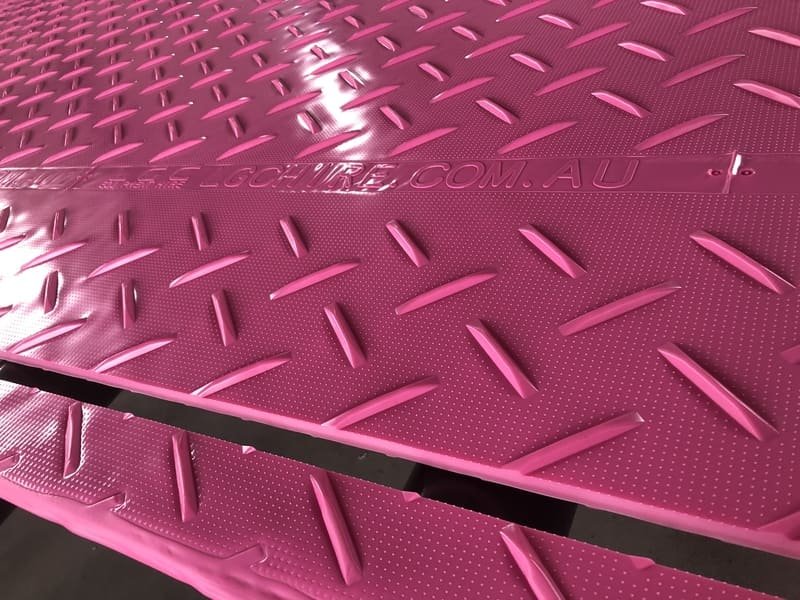
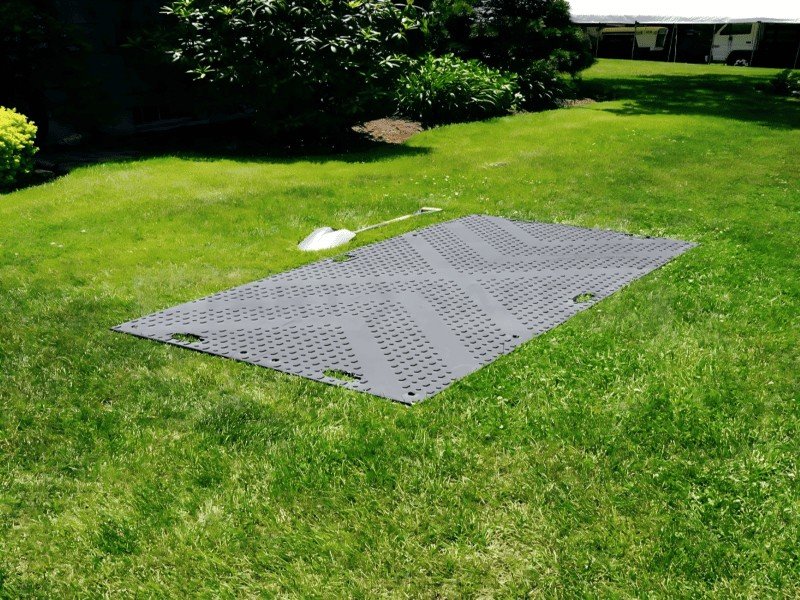
For the main audience field, the best choice is usually pedestrian turf protection flooring, not heavy construction mats.
The surface should feel stable under foot, reduce direct turf wear, allow safe crowd movement, and create a predictable walking surface.
For natural grass, panel design matters. Solid dark coverage can trap heat and block light. Grass under shade or cover loses access to the light it needs for photosynthesis and normal growth.2
That is why light-colored, translucent, raised, or ventilated panels are usually better for long crowd coverage than solid black mats.
The main crowd area needs:
- stable walking surface
- controlled panel gaps
- slip-resistant texture
- drainage or water movement
- airflow under the surface where possible
- light reflection or light transmission where possible
- fast installation and removal
- clean panel joints that do not collect too much debris
If the event lasts only a few hours, the turf may tolerate more. If the field must stay covered overnight or for several days, panel color, airflow, and removal timing become much more important.
Heavy Vehicle Mats Belong in Production Zones
BKM HDPE ground protection mats are useful for stadium event work, but not usually as the full-field audience floor.
They are best used where the pressure is higher:
- backstage vehicle access
- temporary roadways
- forklift routes
- scissor lift routes
- stage equipment movement
- generator access
- barricade delivery
- speaker and lighting transport
- loading and unloading zones
- production storage pads
These zones need stronger mats because carts, forklifts, lifts, and service vehicles create higher loads and more turning force than foot traffic.
HDPE is practical here because it offers a good balance of toughness, moisture resistance, outdoor durability, and reusable handling.3
The mistake is using one material for every zone.
For people, choose for walking comfort and turf recovery. For equipment, choose for load spreading and route control.
Coverage Time Should Be Managed Like a Risk
Time is one of the biggest turf protection factors.
The longer the field stays covered, the more important airflow, light, heat, moisture, and inspection become.
This planning table is not a fixed guarantee, but it is a useful way to think before the event.
| Coverage Time | Turf Risk Level | Practical Action |
|---|---|---|
| Same-day installation and removal | Lower | Still inspect high-traffic zones |
| Full-day event coverage | Medium | Use suitable panels and remove quickly after event |
| Overnight coverage | Higher | Prioritize light-colored or ventilated panels |
| Two-day coverage | High | Plan staged lifting, inspection, and recovery windows |
| Multi-day festival coverage | Very high | Use zone-based flooring and turf recovery plan before setup |
| Hot weather + dark solid coverage | Very high | Avoid long dwell time on valuable natural grass |
| Wet field + heavy crowd | Very high | Add drainage planning and stronger route control |
I know it is tempting to install early so production feels easier. But if the field matters, convenience should not decide the coverage time.
Install as late as realistically possible. Remove as soon as realistically possible.
That single decision can protect more turf than many people expect.
Install by Priority, Not by Convenience
A stadium setup should not start with random panel placement.
Install the routes that protect the field from early damage first.
A practical order is:
| Installation Stage | What Goes Down First | Why It Matters |
|---|---|---|
| 1 | Production access routes | Stops crews from creating shortcuts |
| 2 | Stage and equipment zones | Controls concentrated load areas early |
| 3 | Emergency and service routes | Keeps movement organized during setup |
| 4 | Vendor and cart paths | Prevents repeated cart damage |
| 5 | Main audience flooring | Reduces unnecessary turf coverage time |
| 6 | Edge ramps and transitions | Improves crowd movement and rolling access |
| 7 | Final field inspection | Finds gaps, edges, loose panels, and wet zones |
Do not cover the full field days early just because some production routes are needed.
Protect the working routes first. Cover the main crowd zone later.
Keep Public Routes Connected, Flat, and Clear
A stadium flooring system is not only about grass. It is also about people.
Loose panels, raised edges, wide gaps, and unstable transitions can become trip points. They can also make movement difficult for wheelchairs, strollers, carts, medical teams, and event staff.
Public walking surfaces should stay stable, firm, and slip-resistant. For accessible movement, route width, surface stability, and level changes matter.4
For stadium events, pay special attention to:
- entry gates
- exit paths
- ADA routes
- wheelchair viewing access
- emergency lanes
- medical access
- beverage zones
- food service routes
- toilet queues
- front-of-stage crowd areas
Use connectors, edge ramps, and transition pieces where traffic concentrates.
A good turf plan protects the grass. A good event plan also protects the people walking on it.
Control Load-In and Load-Out
A lot of turf damage happens before the audience arrives.
Forklifts, carts, stage trucks, pallet jacks, generators, barricades, temporary seating, speakers, and lighting equipment can damage the field quickly if crews choose their own paths.
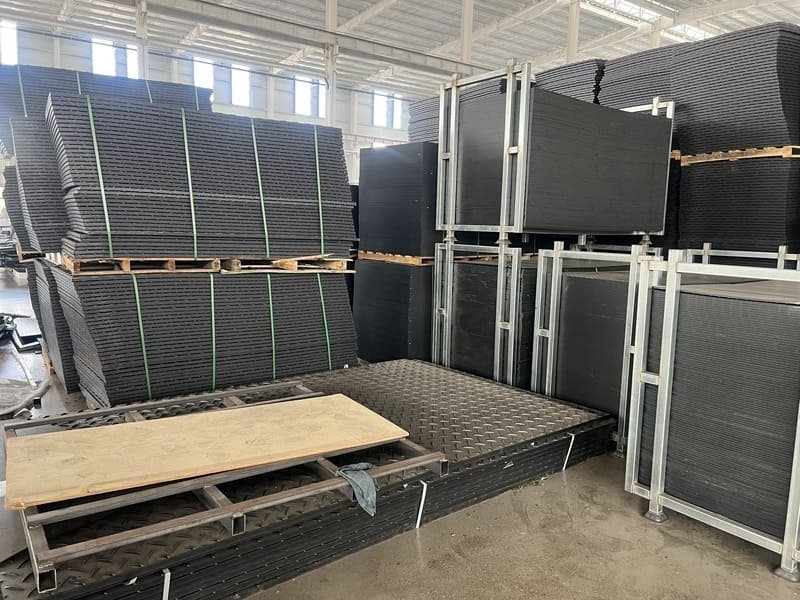
This is where BKM HDPE or composite mats are most useful.
Build production routes before the equipment enters the field.
Do not let load-in crews make shortcuts across unprotected turf. One shortcut can become the route everyone follows.
For equipment routes, use:
- wider mat roads
- connected panels
- extra mats at turning points
- larger work pads at staging zones
- slower vehicle movement
- clear route markings
- spotters where equipment turns
Soil compaction reduces aeration and affects water and oxygen movement in the root zone. Repeated equipment traffic can make recovery harder even after the visible surface is cleaned.5
That is why production routes should be treated as serious turf-risk zones, not just backstage convenience.
Plan for Water, Spills, and Mud
A dry stadium field and a wet stadium field behave differently.
If rain is expected, drainage becomes part of the protection plan.
The flooring should not trap water on top where people may slip. It also should not hold moisture under the panels longer than necessary.
Concert spills add another problem. Drinks, food waste, mud, and litter can collect in panel joints. If panels are removed carelessly, debris can be ground into the turf.
For wet events, plan for:
| Risk Area | Practical Control |
|---|---|
| Rain before setup | Delay full-field cover when possible |
| Standing water | Use drainage paths and avoid sealing low spots |
| Beverage areas | Add inspection and cleaning priority |
| Mud near entrances | Add stronger routes and edge control |
| Vendor routes | Use connected panels for carts |
| Panel joints | Clean debris before removal |
| Post-event removal | Lift panels without dragging waste across turf |
If a zone becomes wet, muddy, or unstable during the event, adjust traffic flow early.
Do not wait until the mud spreads across the field.
Use Light, Translucent, or Ventilated Panels for Longer Coverage
If the turf must stay covered for more than one day, panel color and airflow matter.
Dark surfaces absorb more heat. Light-colored surfaces reflect more sunlight and usually reduce heat buildup.6
For stadium turf, that difference can matter during summer events.
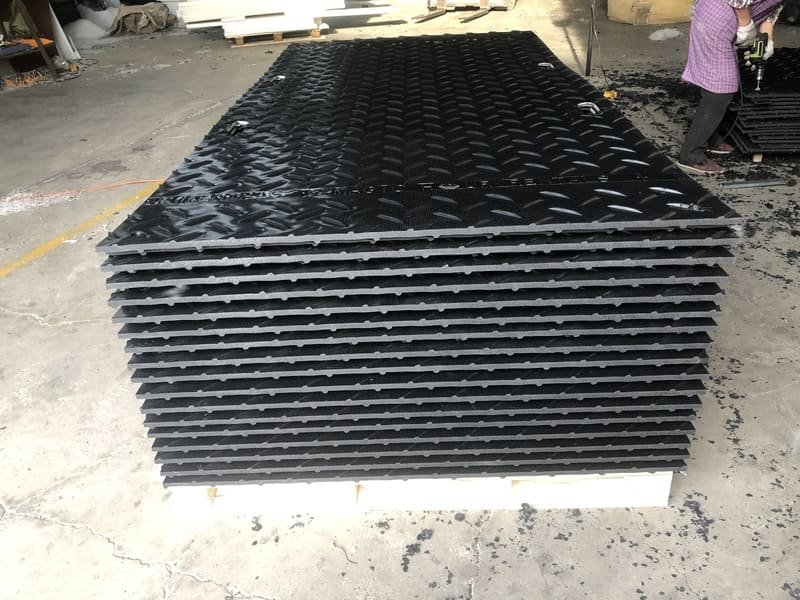
Black HDPE mats can work well for vehicle routes, muddy access, and short-term equipment movement. But they are not the first choice for long-duration audience coverage over pristine natural grass.
For the main field, use lighter, translucent, raised, or ventilated panels where possible.
These panels do not make the turf invincible. Grass still needs air, light, moisture balance, and recovery time.
But they give the field a better chance than heavy solid dark coverage across the full audience area.
Protect Synthetic Turf Differently
Natural grass and synthetic turf are not the same.
Natural grass needs light, air, moisture balance, and root recovery.
Synthetic turf does not need sunlight, but it can still face different risks:
- heat buildup
- infill displacement
- fiber flattening
- seam stress
- surface contamination
- heavy equipment damage
- static load marks
- sharp objects and debris
For synthetic turf, the protection plan should focus more on surface contamination, weight distribution, heat, and preventing equipment from damaging seams or infill.
For natural grass, the plan must also protect living turf health.
If the stadium has hybrid turf, treat it carefully. Hybrid systems combine natural grass with reinforcement, but the living plant still needs recovery time.
Recovery Starts Before the Event
Turf protection does not end when the concert ends.
Before the event, decide how the field will recover.
You may need:
- staged flooring removal
- debris cleanup
- brushing
- irrigation adjustment
- aeration
- divot repair
- overseeding
- turf replacement in high-stress areas
- inspection before the next match
If the next sports match is only a few days away, the protection plan must be stricter.
I would always walk the field before installation and after removal.
Mark weak zones before setup. After removal, inspect these areas first:
| Post-Event Inspection Priority | Why It Matters |
|---|---|
| Front-of-stage zone | Long standing time and spills |
| Entry and exit lanes | Heavy repeated traffic |
| Emergency access routes | Must remain safe and stable |
| Vendor paths | Cart traffic and spills |
| Stage corners | Concentrated load |
| Production routes | Vehicle movement and compaction |
| Low spots | Water and mud risk |
| Panel joint lines | Debris and pressure marks |
The field manager should not discover the worst damage on match day.
BKM Practical Recommendation
For pristine stadium turf, BKM would not recommend one mat type across the whole field.
Use a zone-based plan.
Use pedestrian turf protection panels for the main crowd field. Use connected walkways for aisles, ADA access, emergency routes, and staff movement. Use BKM HDPE or composite ground protection mats for production routes, backstage movement, equipment access, and temporary vehicle roads.
Use heavier mat coverage where forklifts, scissor lifts, loaders, generators, or stage trucks move.
Keep dark solid mats away from long-duration natural grass coverage unless turf appearance is not the priority.
The practical rule is simple: match the surface to the traffic.
People need stable walking panels. Equipment needs load-spreading mats. Turf needs the shortest realistic coverage time.
BKM can support HDPE ground protection mats in common sizes and custom dimensions, with surface textures, colors, hand holes, connector holes, logo marking, private-label needs, and export packaging.
BKM also provides connector systems for mat layouts. Turf-specific pedestrian panels, ramps, underlayment, storage systems, and field recovery supplies can be prepared according to the venue’s event plan.
FAQ
Can concertgoers stand directly on stadium grass?
They can, but it is risky. Thousands of repeated steps can cause wear, compaction, muddy areas, and visible turf decline, especially if the field is wet or the event lasts many hours.
What is the best flooring for stadium concert crowds?
For the main audience area, use pedestrian turf protection panels that create a stable walking surface and reduce direct turf wear. For longer coverage, light-colored, translucent, raised, or ventilated panels are usually better for natural grass.
Should black HDPE mats be used over stadium turf?
Use black HDPE mats mainly for vehicle routes, production access, equipment movement, and short-term heavy-duty zones. For long audience coverage over valuable natural grass, lighter or ventilated turf protection panels are usually safer.
How long can stadium turf stay covered?
There is no single safe time. Same-day coverage carries less risk than overnight or multi-day coverage. Heat, moisture, panel color, grass type, and field condition all change the safe window. Install as late as possible and remove as soon as possible.
Do pedestrians and vehicles need different mats?
Yes. Pedestrian flooring should be stable, comfortable, connected, and turf-conscious. Vehicle routes need stronger HDPE or composite mats that can handle higher loads and turning forces.
How do you protect turf during stage setup?
Build protected production routes before equipment enters the field. Use stronger mats for forklifts, trucks, lifts, carts, and stage equipment. Do not allow crews to create shortcuts across unprotected turf.
What areas need the strongest protection?
Stage zones, loading routes, forklift paths, scissor lift routes, generator access, front-of-stage areas, entrances, exits, and wet low spots usually need the most attention.
What should happen after the concert?
Remove flooring in stages, clean debris before dragging panels, inspect high-traffic zones first, restore airflow and light quickly, and begin the turf recovery plan before the next field use.
Conclusion
Protecting pristine stadium turf from thousands of walking concertgoers takes more than covering the field.
You need a zone-based temporary flooring plan.
The main crowd area needs turf-conscious pedestrian panels. Production routes need stronger HDPE or composite ground protection mats. Emergency paths, ADA routes, vendor lanes, and stage zones all need their own protection logic.
The best plan reduces traffic damage, limits coverage time, controls water and debris, and gives the turf a recovery path before the event even begins.
At BKM, our practical rule is simple: protect the turf by zone, not by guesswork.
The right mat in the right place helps the event run smoothly and gives the field the best chance to recover after the crowd leaves.
References
UMass Amherst Center for Agriculture, Food, and the Environment. “Traffic Stress & Turf Cultivation.” https://www.umass.edu/agriculture-food-environment/turf/best-management-practices-bmps-for-lawn-landscape-turf/9-traffic-stress-turf-cultivation ↩
UMass Amherst Center for Agriculture, Food, and the Environment. “Growing Turf Under Shaded Conditions.” https://www.umass.edu/agriculture-food-environment/turf/fact-sheets/growing-turf-under-shaded-conditions ↩
Plastics Europe. “Polyolefins.” https://plasticseurope.org/plastics-explained/a-large-family/polyolefins/ ↩
U.S. Access Board. “Chapter 3: Floor and Ground Surfaces.” https://www.access-board.gov/ada/guides/chapter-3-floor-and-ground-surfaces/ ↩
UMass Amherst Center for Agriculture, Food, and the Environment. “Compaction and Cultivation.” https://www.umass.edu/agriculture-food-environment/turf/fact-sheets/compaction-cultivation ↩
U.S. Environmental Protection Agency. “Using Cool Roofs to Reduce Heat Islands.” https://www.epa.gov/heatislands/using-cool-roofs-reduce-heat-islands ↩