
 English
 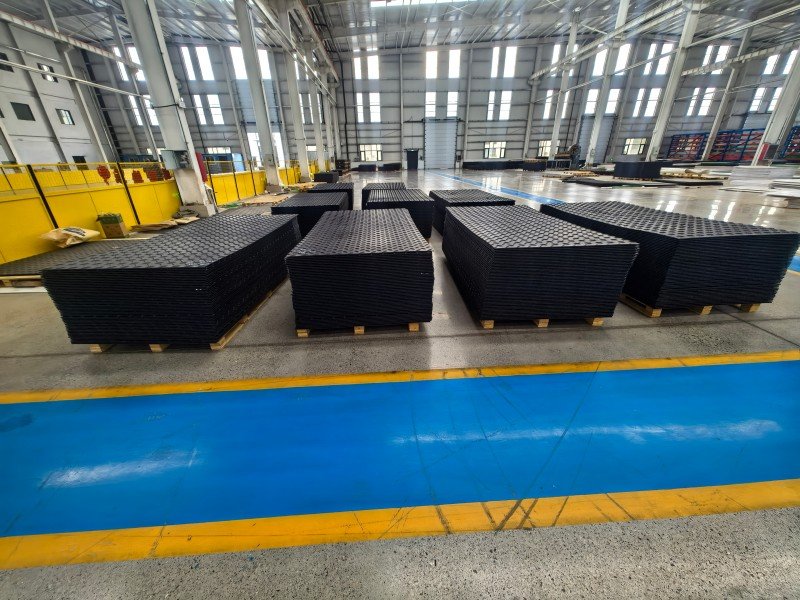 A steel road plate and an HDPE ground protection mat may both look like temporary access panels, but using the wrong one can create a serious problem.
Use HDPE mats over an open trench, and you may be asking a plastic mat to do a bridge’s job. Use steel plates across a lawn, paver driveway, or event field, and you may damage the very surface you meant to protect.
The real choice is not “steel or plastic.” The real choice is bridging or ground protection.
This article will help you decide when steel road plates are required, when HDPE ground protection mats are the better choice, and how to avoid using the wrong product on trenches, soft ground, turf, pavers, event sites, and temporary access roads.
The Core Difference: Bridging vs Ground Protection
Steel road plates and HDPE ground protection mats solve different problems.
Steel road plates are used when you need to cover or span an opening, such as a trench, excavation, utility cut, or road opening.
HDPE ground protection mats are used when the ground is still continuous but needs surface protection, load spreading, mud control, or temporary access.
| Job Condition | Better Choice | Reason |
|---|---|---|
| Open trench | Steel road plate | Needs structural bridging |
| Utility cut in a road | Steel road plate | Needs traffic-rated coverage |
| Unsupported gap | Steel road plate or engineered bridging system | Plastic mats are not bridges |
| Soft but continuous ground | HDPE ground protection mat | Needs load spreading, not bridging |
| Grass or turf protection | HDPE ground protection mat | Easier handling and better surface protection |
| Muddy temporary access | HDPE ground protection mat | Reduces rutting and creates a route |
| Pavers or decorative concrete | HDPE ground protection mat | Less aggressive than steel |
| Event walkway | HDPE ground protection mat | Better for pedestrian comfort and fast installation |
| Public road trench cover | Steel road plate | Usually requires local approval and traffic design |
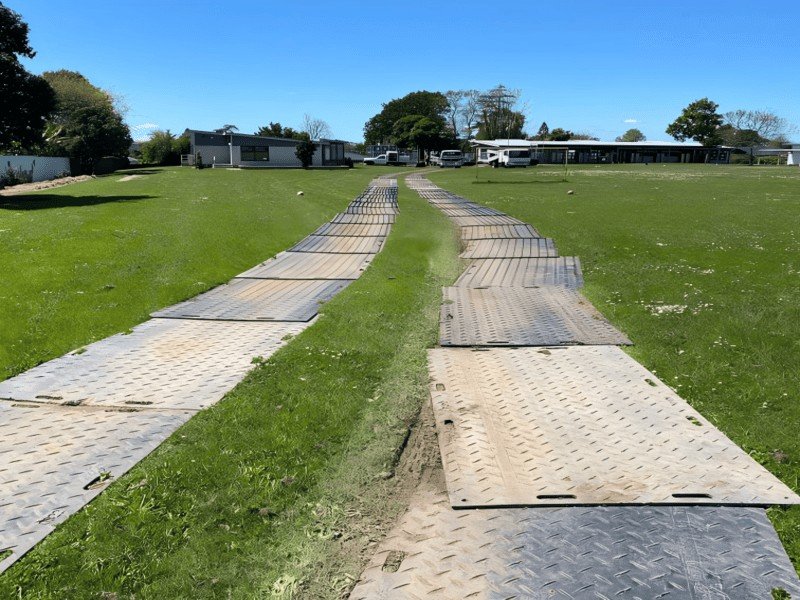
| Construction site vehicle route over soil | HDPE ground protection mat | Reusable access over supported ground |
At BKM, I would explain it this way:
Use steel when you need to bridge. Use HDPE when you need to protect supported ground.
What Steel Road Plates Are Used For
Steel road plates are heavy steel panels used to cover trenches, excavations, road cuts, utility openings, and temporary work zones.
They are common in:
- road repair
- pipeline work
- municipal utility repair
- trenching projects
- civil construction
- public roadway work
- excavation access control
The main purpose is to let vehicles or pedestrians pass over a temporary opening or unstable work area.
For this type of application, HDPE ground protection mats should not replace steel road plates.
A ground protection mat is designed to spread load over ground that still supports it. It is not designed to span an open trench or unsupported void.
Some public agencies require steel plates over open trenches to withstand traffic loading, resist movement, control noise, and maintain a non-skid surface.1
That is why trench covering should be treated as an engineered safety decision, not a normal mat selection decision.
What HDPE Ground Protection Mats Are Used For
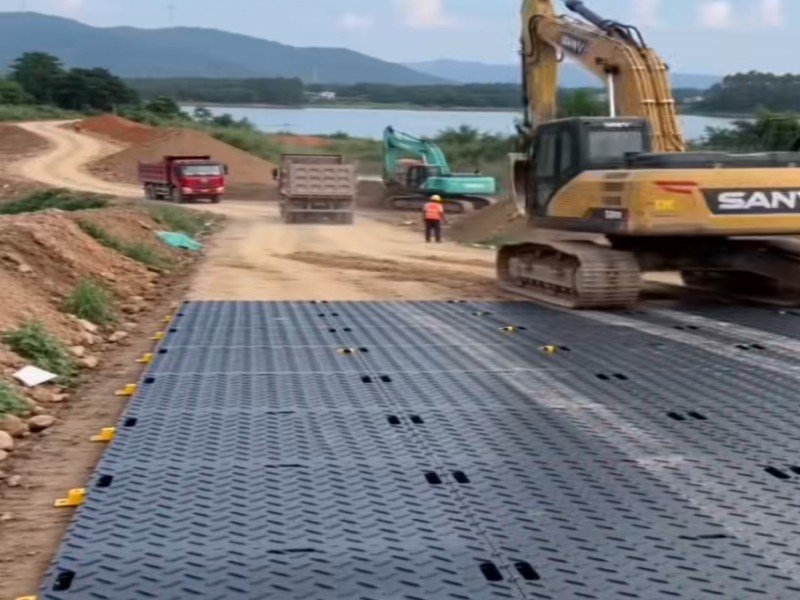
HDPE ground protection mats are used to create temporary access over soft, sensitive, or finished ground.
They are commonly used on:
- grass
- turf
- mud
- soil
- clay
- sand
- gravel
- construction entrances
- temporary parking areas
- landscaping sites
- event grounds
- farm routes
- utility access paths
- pavers and finished surfaces
Their job is to spread load, reduce rutting, control mud, protect surfaces, and provide a reusable access route.
HDPE belongs to the polyolefin family and is widely used because it offers a useful balance of toughness, moisture resistance, outdoor durability, and practical handling.2
For BKM applications, HDPE mats are suitable when you need:
- temporary construction access
- lawn and turf protection
- landscaping equipment routes
- mini-excavator or skid steer access
- event walkways
- temporary parking areas
- farm and utility access
- reusable rental mats
But they are not designed to cover holes, trenches, or unsupported edges.
Weight Difference: This Changes the Jobsite
The handling difference between steel and HDPE is one of the biggest practical differences.
Steel is strong, but it is extremely heavy.
Using a common steel plate weight calculation, a 1-inch steel plate weighs about 40.8 lb per square foot. A 1/2-inch plate weighs about 20.4 lb per square foot.3
That means a 4 ft × 8 ft steel plate weighs approximately:
| Plate Type | Size | Approx. Weight |
|---|---|---|
| 1/2 in steel plate | 4 ft × 8 ft | 653 lb |
| 3/4 in steel plate | 4 ft × 8 ft | 979 lb |
| 1 in steel plate | 4 ft × 8 ft | 1,306 lb |
| HDPE ground protection mat | 4 ft × 8 ft | Often about 60–100 lb, depending on thickness and design |
This is why steel plates usually require lifting equipment, chains, forklifts, excavators, or cranes to move and place.
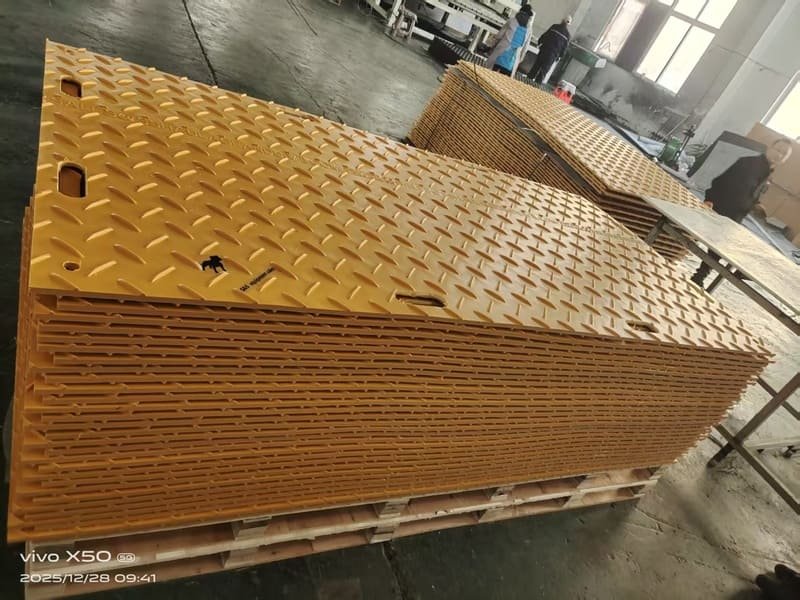
HDPE ground protection mats are much easier to deploy. Many can be moved by two workers using hand holes, depending on size and weight.
If your crew needs to protect a lawn, driveway, backyard, event field, or temporary parking area quickly, HDPE is usually much more practical.
The mat that is easier to move is often the mat that actually gets installed correctly.
Load Support: Steel Bridges, HDPE Spreads
Steel road plates and HDPE mats manage load in different ways.
Steel plates can bridge openings when properly sized, supported, secured, and approved.
HDPE mats spread load over a wider area, but they still need ground underneath.
This distinction matters.
| Load Situation | Steel Road Plate | HDPE Ground Protection Mat |
|---|---|---|
| Open trench | Correct product when engineered | Not suitable |
| Utility road cut | Correct product when approved | Not suitable |
| Unsupported void | Use engineered steel or bridging system | Not suitable |
| Soft mud over continuous ground | Often unnecessary and hard to handle | Suitable with correct layout |
| Lawn access | Too heavy and aggressive for many jobs | Suitable |
| Temporary equipment route | Only if structural coverage is needed | Suitable over supported ground |
| Crane outrigger load | May still need engineered design | Use outrigger pads, not standard mats alone |
| Repeated vehicle access over soil | Usually impractical | Suitable with proper mat design |
For BKM customers, the key rule is simple:
If the ground is weak but continuous, HDPE mats can help.
If there is an open gap, trench, or unsupported void, use steel road plates or another engineered bridging system.
Traction and Wet Conditions
Steel plates can become slippery when wet, especially if the surface is smooth.
For roadwork and pedestrian areas, steel plates may need skid-resistant treatment or surface control, depending on site conditions and local requirements. Some municipal requirements specifically mention non-skid steel plate surfaces for trench covers.1
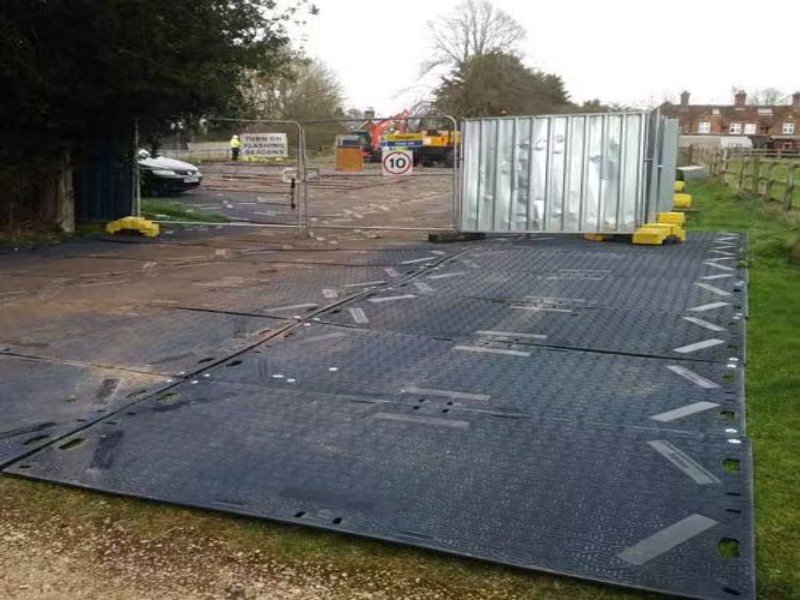
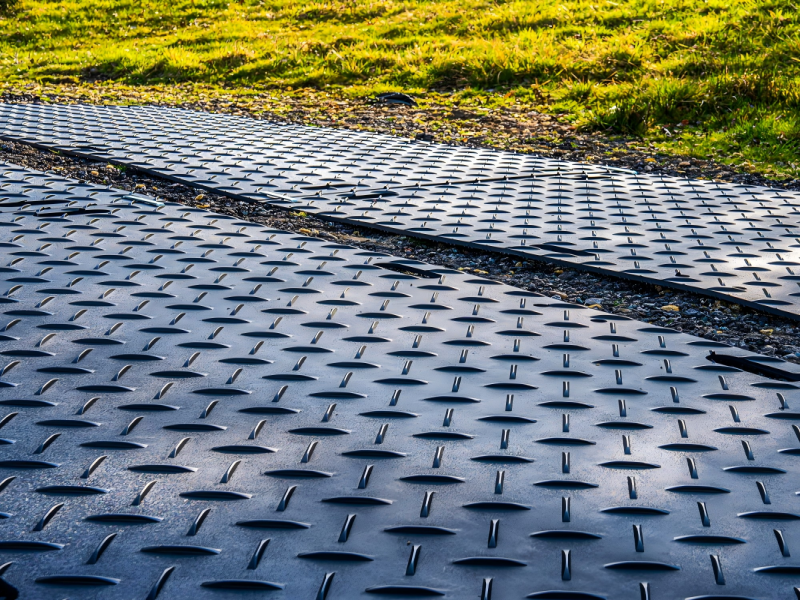
HDPE ground protection mats are usually designed with traction surfaces, such as:
- diamond tread
- raised cleats
- dual-sided patterns
- pedestrian-friendly texture
- vehicle traction pattern
These textures help tires, tracks, boots, carts, and light equipment move more confidently across the temporary route.
This does not mean HDPE mats are never slippery.
Mud, clay, oil, algae, ice, worn surfaces, or poor installation can reduce traction on any material.
But for muddy access, grass protection, event walkways, and temporary site routes, textured HDPE mats usually provide a more practical surface than smooth steel plates.
Surface Protection: HDPE Is Usually Better for Finished Ground
If the goal is surface protection, HDPE is usually the better choice.
Steel plates are heavy and aggressive. They can scratch, crush, chip, or mark finished surfaces if not handled carefully.
That matters on:
- premium concrete
- stamped concrete
- pavers
- asphalt edges
- lawns
- sports turf
- golf courses
- event fields
- hotel lawns
- school grounds
- parks
- residential driveways
Steel plates can also create difficult transitions because of weight and plate edge height.
HDPE mats are lighter, easier to place, and more suitable for protecting supported surfaces.
For premium concrete or pavers, BKM may recommend placing a clean, thin protective fabric under HDPE mats to reduce abrasion from grit trapped underneath.
I would rather prevent one visible scratch at the beginning than explain it after the job is done.
Pedestrian Routes and Event Sites
For pedestrian routes, comfort and surface stability matter.
Public walking surfaces should be stable, firm, and slip-resistant. This is especially important for event visitors, carts, strollers, wheelchairs, and staff movement.4
Steel plates can feel harsh, noisy, slippery, and intimidating in public-facing areas.
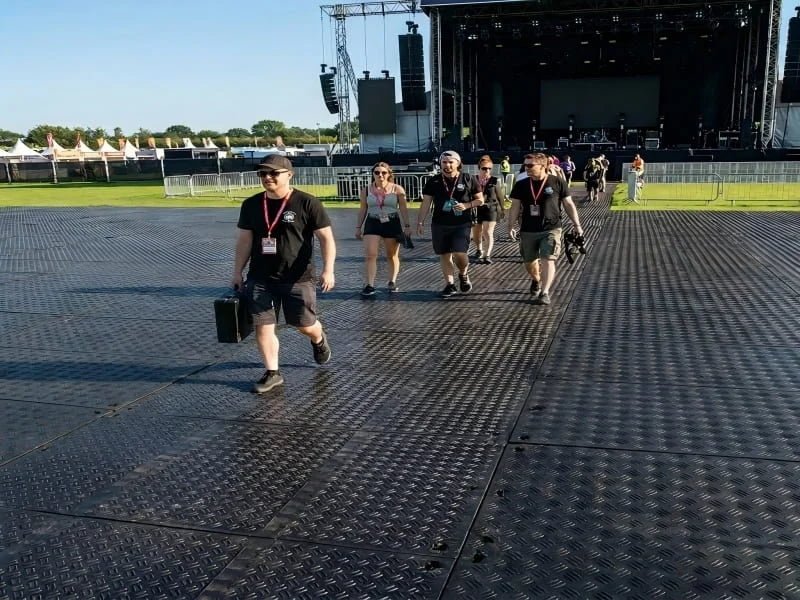
HDPE mats are usually more suitable for:
- event walkways
- temporary pedestrian paths
- lawn access
- festival routes
- school event access
- park maintenance routes
- hotel and venue setups
- temporary parking guidance
They are easier to install, easier to remove, and quieter under foot traffic.
For public routes, connectors and edge control are important. Loose mats can create gaps, raised edges, or trip points.
Noise, Vibration, and Site Comfort
Steel road plates can be noisy when vehicles pass over them, especially if the plate is not seated or secured properly.
Movement, vibration, and edge impact can create clanging noise.
Some public works requirements for steel plates mention movement and noise control because loose plates can become a problem under traffic.1
HDPE mats are generally quieter and more suitable for residential landscaping, event venues, schools, parks, hotels, and customer-facing work areas.
If your job is in a neighborhood or premium property, the quieter and cleaner access route matters.
People may not notice the mat when everything goes well. They will notice the noise, damage, or mess when it does not.
Installation Speed and Labor
Steel plates usually take more planning and equipment to install.
You may need:
- lifting equipment
- chains or rigging
- trained operators
- traffic control
- edge treatment
- anti-skid treatment
- road authority approval
- securing methods
- engineering review
HDPE ground protection mats are faster to deploy.
Workers can usually carry, align, connect, move, wash, stack, and remove them with simpler tools.
| Installation Factor | Steel Road Plate | HDPE Ground Protection Mat |
|---|---|---|
| Manual handling | Usually not practical | Often practical with 2 workers |
| Lifting equipment | Usually required | Often not required |
| Relocation | Slower | Faster |
| Cleaning | More difficult on site | Easier |
| Storage | Heavy-duty storage required | Easier stacking and transport |
| Best use pattern | Fixed trench cover | Moving access route |
| Crew flexibility | Lower | Higher |
If the route changes during the job, HDPE mats are much easier to adjust.
Steel plates are better when the plate stays in one engineered location, such as a trench cover.
Cost and ROI
Steel plates can be expensive to buy, transport, lift, install, secure, and remove.
But when the job requires structural trench coverage, the cost is justified.
That is not where you should try to save money by switching to plastic.
HDPE mats create value in a different way.
Their ROI comes from:
- faster installation
- lower handling cost
- repeated reuse
- less ground repair
- less mud cleanup
- fewer stuck vehicles
- easier storage
- better surface protection
- rental fleet potential
If you need temporary access over grass or mud every week, HDPE mats can become a reusable asset.
If you only need to cover an open trench, HDPE is not the right comparison.
When Steel Road Plates Are the Better Choice
Choose steel road plates when the job requires bridging, structural coverage, or public-road trench protection.
Steel is usually the better choice for:
- open trenches
- utility cuts
- excavations
- road openings
- public traffic coverage
- temporary bridge-like coverage
- municipal utility work
- highway or street repair
- approved trench-cover systems
- unsupported gaps
If the area below the plate is open or unsupported, do not use standard HDPE mats as a substitute.
That decision can turn a surface protection product into a safety risk.
When HDPE Ground Protection Mats Are the Better Choice
Choose HDPE ground protection mats when you need to protect the ground rather than bridge a hole.
HDPE mats are usually better for:
- construction site access
- muddy routes
- soft soil
- grass protection
- turf protection
- landscaping routes
- mini-excavator access
- skid steer access
- temporary parking
- festivals and outdoor events
- pedestrian walkways
- farm access
- utility access over fields
- pavers and finished surfaces
- reusable rental mats
HDPE is also better when your crew needs fast installation, lighter handling, easy cleaning, and repeated reuse.
Can Steel Plates and HDPE Mats Be Used Together?
Yes. In some projects, steel plates and HDPE mats can work together.
For example:
- steel plates cover the trench
- HDPE mats protect the grass beside the trench
- steel plates bridge the road cut
- HDPE mats create the equipment route to the work area
- steel plates cover the excavation
- HDPE mats protect pavers, lawns, or staging zones nearby
This combined approach is often better than forcing one product to do everything.
The important thing is to keep the roles clear.
Steel handles bridging.
HDPE handles supported-ground access and surface protection.
BKM Practical Recommendation
If your project involves an open trench, road cut, excavation, or unsupported void, do not use HDPE ground protection mats as a substitute for steel road plates.
Use properly sized steel plates and follow local requirements.
If your project involves soft ground, wet grass, mud, temporary parking, lawn protection, event access, landscaping routes, or repeated site movement, HDPE ground protection mats are usually the more practical solution.
For many jobs, the right plan may use both products: steel plates for trench coverage and HDPE mats for the surrounding access route.
BKM can support HDPE ground protection mats in common sizes and custom dimensions, with surface texture options, hand holes, connector holes, custom colors, logo marking, private-label needs, and export packaging.
BKM also provides connector systems for mat layouts. Other site accessories, such as ramps, hooks, storage racks, straps, anchors, or underlayment, can be prepared locally if your project requires them.
FAQ
Are steel road plates stronger than HDPE ground protection mats?
Yes, for structural bridging and trench coverage, steel road plates are much stronger. HDPE mats are designed for load spreading over supported ground, not for covering open gaps.
Can HDPE ground protection mats replace steel road plates?
No, not when the job involves trenches, road openings, excavations, or unsupported voids. HDPE mats should not be used as bridge plates.
Are HDPE mats easier to move than steel plates?
Yes. A 4 ft × 8 ft steel plate can weigh hundreds or more than a thousand pounds depending on thickness, while many 4 ft × 8 ft HDPE mats are often around 60–100 lb, depending on design.
Which is better for lawn protection?
HDPE ground protection mats are usually better for lawn and turf protection. Steel plates are too heavy and aggressive for many finished grass areas.
Which is better for temporary roads?
For temporary roads over supported soil, grass, mud, or gravel, HDPE mats are usually practical. For roads crossing trenches or excavations, steel plates are needed.
Are steel road plates slippery when wet?
They can be. Steel plates used in traffic or pedestrian areas may need anti-skid treatment, depending on site conditions and local requirements.
Can HDPE mats handle vehicles?
Yes, when the mat is selected for the load and the ground underneath provides support. The layout, connector system, surface texture, vehicle weight, and ground condition all matter.
Can steel plates damage pavers or concrete?
Yes. Steel plates can scratch, chip, mark, or overload finished surfaces if not installed carefully. For premium pavers or concrete, HDPE mats with a clean protective layer may be more suitable when bridging is not required.
Conclusion
Steel road plates and HDPE ground protection mats solve different problems.
Steel road plates are the better choice for trenches, excavations, road openings, and structural bridging. They are strong, heavy, and suitable for engineered temporary road coverage when installed correctly.
HDPE ground protection mats are the better choice for temporary access over supported ground. They protect grass, mud, soil, pavers, event grounds, and construction routes while staying easier to handle, install, clean, and reuse.
The safest decision starts with one question:
Do you need to bridge an unsupported opening, or do you need to protect supported ground?
If you need to bridge, use steel.
If you need to protect and access supported ground, HDPE ground protection mats are usually the practical choice.
References
City of Long Beach Public Works. “Steel Plate Requirements for Open Trench.” https://www.longbeach.gov/globalassets/pw/media-library/documents/resources/engineering/standard-plans/100-general-roadwork/section-129---steel-plate-requirements-for-open-trench ↩
Plastics Europe. “Polyolefins.” https://plasticseurope.org/plastics-explained/a-large-family/polyolefins/ ↩
Engineering ToolBox. “Steel Plates - Weight.” https://www.engineeringtoolbox.com/steel-plates-weight-d_1561.html ↩
U.S. Access Board. “Chapter 3: Floor and Ground Surfaces.” https://www.access-board.gov/ada/guides/chapter-3-floor-and-ground-surfaces/ ↩