
 English
 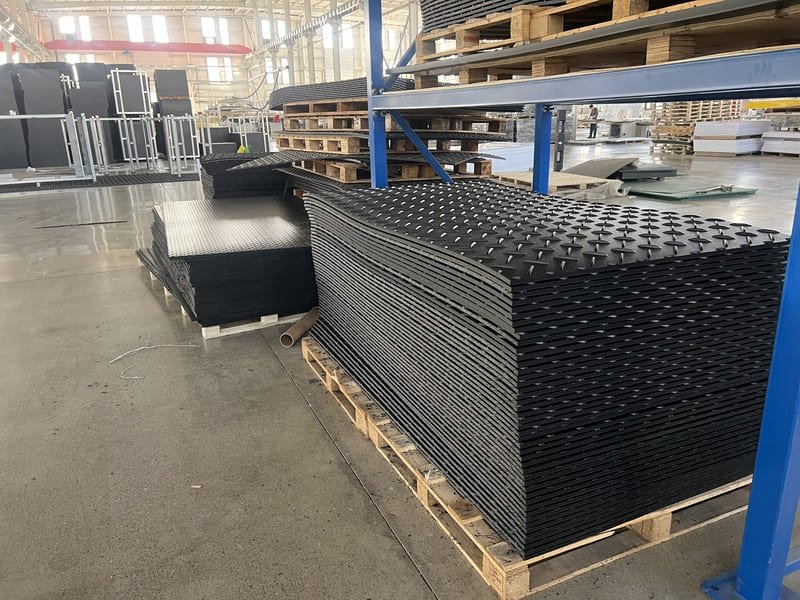 You may save money with plywood on the first day. But after rain, mud, truck turns, cleanup, and repeated use, plywood can become the expensive choice.
For most construction sites, composite ground mats are the better long-term option. They handle wet ground better, give more stable support, reduce splintering, clean more easily, and can be reused across many projects.
So why do many contractors still start with plywood? Because the first price is easy to see, while the real jobsite cost usually appears later. Keep reading, and you will know when plywood is enough—and when composite mats are the smarter investment.
Why You Are Comparing Composite Mats and Plywood
You are probably not comparing these two materials because you are curious about plastic and wood. You are comparing them because you need a temporary surface that will not fail when the site becomes wet, muddy, or busy.
Maybe you need to protect a construction entrance. Maybe trucks must cross soft ground for several weeks. Maybe your crew has used plywood before, but it broke, warped, or became slippery after rain.
If you rent mats, the problem is even more direct. You need something that can be delivered, used, cleaned, stacked, and rented again. A product that only survives one job does not support a rental business.
If you are managing construction access, your real concern is schedule control. When the access route breaks down, the whole job slows down.
So the question is not simply “Which material is stronger?” The better question is: which material gives you lower cost and fewer site problems after real use?
How I Judge This Choice
When I compare composite ground mats with plywood, I do not start with unit price. I start with the job conditions.
I look at ground moisture first. Wet ground changes everything. A material that works on a dry morning may fail after rain and repeated traffic.
Then I look at traffic. A few workers walking across a dry area is one thing. Loaded trucks, forklifts, skid steers, and telehandlers turning on soft ground are completely different.
I also look at reuse. If you only need one quick cover for a dry, light-duty area, plywood may still make sense. But if you expect repeat use, washing, transport, storage, and vehicle access, composite mats usually have the advantage.
This is the framework I would use before recommending either option:
| Question | Why It Matters |
|---|---|
| Is the site wet or muddy? | Plywood loses stability faster when moisture is involved. |
| Will vehicles turn, brake, or reverse? | Side force can shift or break loose sheets. |
| Will the material be reused? | Composite mats usually make more sense for repeated projects. |
| Does the route need traction? | Textured composite mats can offer better surface grip. |
| Do you need a connected route? | Composite mats can use connector systems; plywood usually cannot. |
| Is this for rental or resale? | Cleaning, stacking, branding, and repeat handling become important. |
What “Composite Ground Mats” Means in Real Site Use
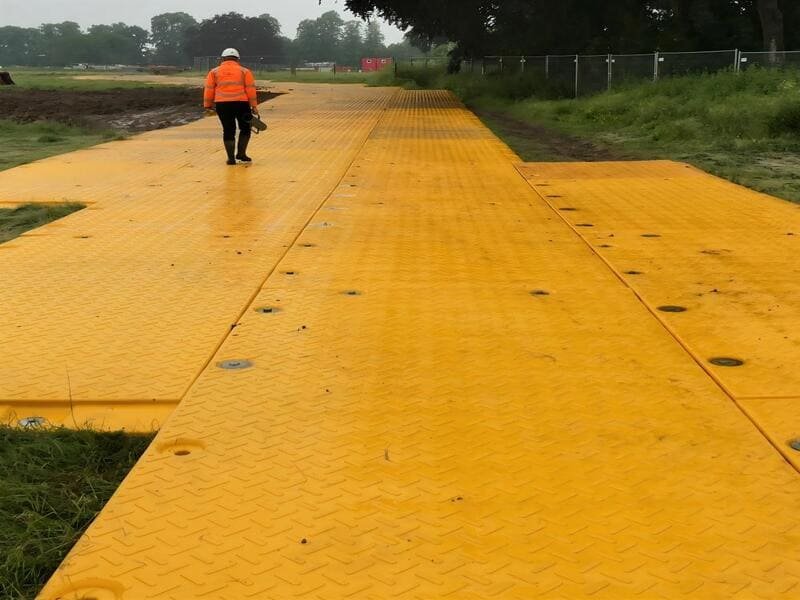
In ground protection work, composite ground mats usually refer to reusable mats made from HDPE, reinforced polymers, or engineered plastic structures. For BKM, HDPE ground protection mats are the most practical option for many construction, landscaping, event, utility, farm, and rental applications.
HDPE belongs to the polyolefin family. Plastics Europe describes HDPE as a polyethylene material known for its large strength-to-density ratio, hardness, and useful durability in many product applications.1
These mats are designed to create temporary access over mud, grass, soil, gravel, and other outdoor surfaces. They are not just flat covers.
A proper mat may include a textured surface, hand holes, connector holes, and enough body strength for repeated handling. These details matter when your crew needs to install, remove, wash, and use the mats again.
Plywood is different. It is a wood-based sheet material. It may cover the ground for a short time, but it is not designed as a reusable temporary access system.
That difference becomes clear when traffic repeats.
Moisture Is Where Plywood Usually Starts to Lose
Construction sites rarely stay clean and dry.
A plywood sheet may look acceptable on the first day. After rain, mud, tire movement, and repeated handling, the sheet can absorb water, swell, warp, split, or become slippery.
Wood moisture directly affects physical behavior, dimensional change, and performance. USDA Forest Service research on wood moisture relations explains why wood-based materials respond differently as moisture content changes.2
Once the edges break, the sheet becomes harder to align. Once the surface becomes slippery, it creates more risk for workers and small equipment.
I have seen projects where plywood was chosen because the first price was low. After two wet days, the discussion changed. The question became how to replace broken sheets and clean up the damaged route.
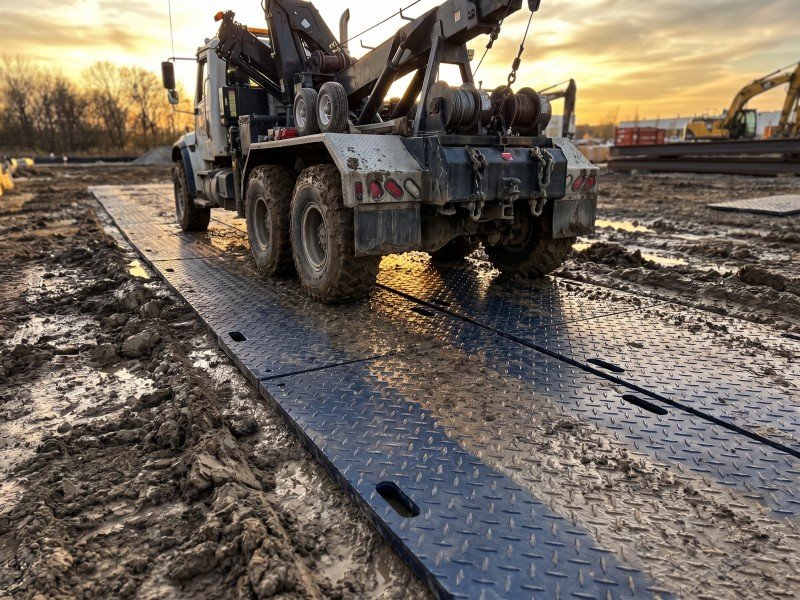
Composite mats are better suited for this environment. HDPE does not absorb water like plywood, and the mat can usually be washed after muddy use.
For your job, this means the access route has a better chance of staying usable after weather changes.
Composite Mats Give More Consistent Support
A construction route needs more than a cover. It needs a surface that helps spread load.
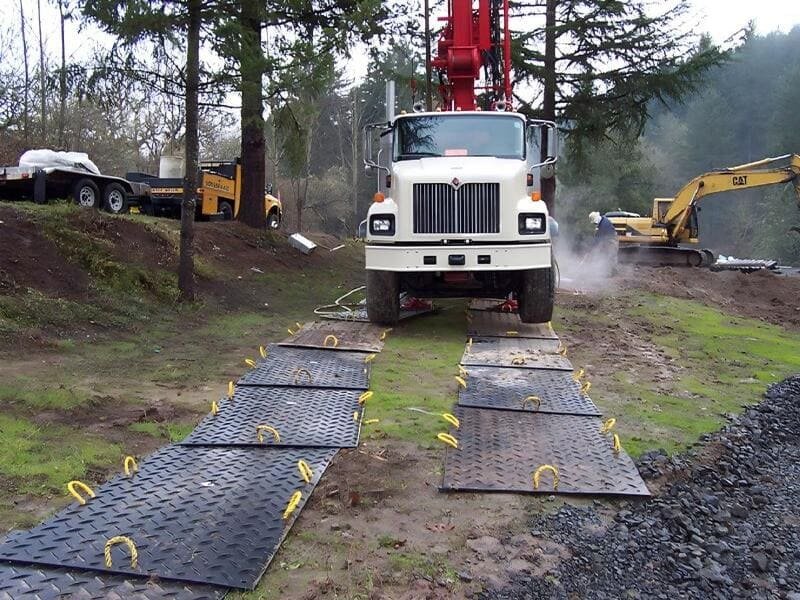
When a vehicle drives over soft ground, pressure is concentrated under the tires or tracks. A proper ground mat spreads that load over a wider area and helps reduce rutting.
Soil condition matters. Iowa State University Extension notes that wet soil and field traffic increase the chance of soil compaction, especially when heavy equipment is involved.3
Plywood can provide some temporary support. But its performance changes as it becomes wet, cracked, bent, or damaged.
Composite ground mats are made for repeated movement when the mat, ground, and layout are matched correctly. They are more predictable than loose plywood sheets under regular vehicle traffic.
This does not mean composite mats solve every ground problem. If the soil is deeply saturated, hollow, or unsupported, the mat still needs proper ground support.
A loaded truck driving straight across firm ground is not the same as a truck turning repeatedly on wet clay. I would never judge those two jobs by the same product photo.
Traction and Stability Matter More Than They Seem
Plywood can become slippery when wet. Broken plywood can also create splinters, raised edges, and uneven walking areas.
On a construction site, the access route may be used by many people and machines in one day. Workers, subcontractors, forklifts, carts, skid steers, and trucks may all cross the same area.
OSHA’s walking-working surface standard requires walking-working surfaces to be maintained in a clean, orderly, and sanitary condition, and it also addresses hazards such as sharp or protruding objects, loose boards, leaks, spills, snow, and ice.4
Composite mats are usually designed with traction surfaces. Diamond tread, cleat patterns, or raised textures help improve contact for tires, tracks, boots, and carts.
Many composite mats can also be connected. This is a major difference from plywood.
Loose plywood sheets may shift, overlap, or separate when vehicles turn or brake. Connected mats behave more like a planned temporary route.
If your site has repeated traffic, connectors are not a small detail. They help the mat system stay aligned.
Plywood Can Still Make Sense in Some Jobs
Plywood is not useless.
If you need a few sheets for a dry, short, low-risk area, plywood may be acceptable. It is easy to buy locally and easy to cut.
It may also work when the ground underneath is already firm and you only need light surface protection.
But plywood becomes less attractive when the job involves wet weather, muddy access, vehicle traffic, turning movement, or repeated use.
If you expect the material to return clean, strong, and ready for the next job, plywood is usually the wrong expectation.
For one simple task, plywood may be cheaper. For regular construction access, composite mats usually make more sense.
Composite Mats Are Usually Better for Repeat Use
Composite mats cost more upfront, but they are designed for repeated installation, removal, washing, stacking, transport, and reuse.
That changes the cost calculation.
You should not only ask, “Which one costs less today?” You should ask, “How many jobs can this product support?”
If plywood fails after a few wet jobs, you pay again. You also pay for disposal, cleanup, replacement transport, and possible ground repair.
If composite mats can be used across many projects, the cost per use may become much lower.
This is especially important for rental companies, event suppliers, landscaping contractors, utility crews, and construction fleets.
A reusable mat is not only a material purchase. It is an operating asset.
Cleaning and Handling Affect Your Real Cost
After the job, the material still needs to be handled.
Plywood can absorb mud, water, oil, and site debris. Once it becomes soaked, it is harder to clean and unpleasant to move.
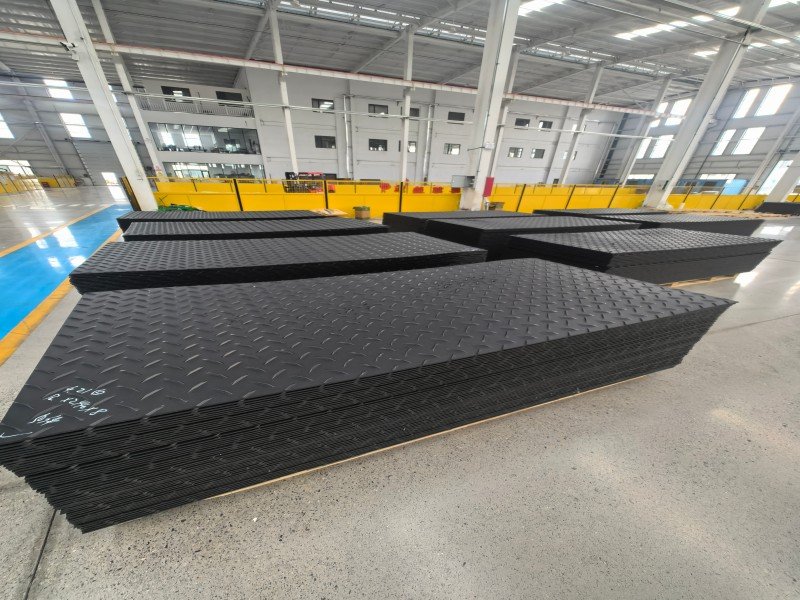
Composite mats are easier to wash and inspect. They can be stacked, stored, and prepared for the next project.
For BKM, this is part of product performance. A mat should not only survive the job. It should also be practical after removal.
If you rent mats, cleaning speed affects profit. If you manage several jobs, stacking and transport affect labor.
A product that is cheaper to buy but slower to handle may not be cheaper in operation.
Practical Comparison
| Factor | Composite Ground Mats | Traditional Plywood |
|---|---|---|
| Wet condition performance | Better moisture resistance | Absorbs water and may warp |
| Reuse | Designed for repeated use | Often short service life outdoors |
| Traction | Usually textured surface | Can become slippery when wet |
| Load support | More predictable when selected correctly | Limited and less consistent |
| Connection system | Connector holes often available | Usually none |
| Cleaning | Easier to wash | Absorbs mud and water |
| Upfront cost | Higher | Lower |
| Cost per use | Usually better for repeated use | Often rises after replacement |
| Best use | Construction access, temporary roads, equipment routes | Light, dry, short-term protection |
This comparison does not mean composite mats win every job. It means you should match the material to the real work.
For a light, dry, one-time cover, plywood may be enough. For wet, repeated, vehicle-based work, composite mats usually perform better.
Where Composite Mats Are the Better Choice
Composite ground mats are usually the better choice when the access route matters to the project schedule.
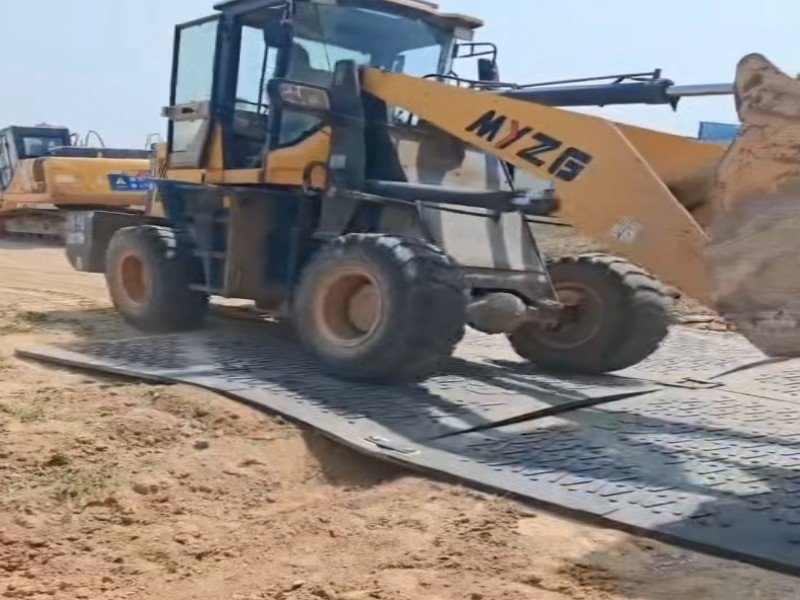
They are useful for construction entrances, muddy equipment routes, temporary roads, staging zones, utility access, and repeated site traffic.
EPA’s construction stormwater BMP guidance highlights the role of site controls, stabilized entrances, sediment control, and construction-phase planning. This supports the same practical point: access routes should be managed before they become a source of mud, runoff, or site damage.5
Composite mats are also better when your business depends on reuse. If you need to clean, stack, transport, and use the mats again, plywood is usually not a strong long-term answer.
For event suppliers and rental businesses, composite mats can improve product presentation. A clean, reusable mat fleet looks more professional than damaged plywood sheets.
For construction teams, the benefit is site control. A planned mat route tells vehicles where to move and helps reduce random traffic damage.
In my experience, that control is often underestimated. The mat does more than cover the ground. It helps organize the site.
Know the Limit: Mats Are Not Bridges Over Unsupported Ground
Composite mats are useful, but they still need support underneath.
Do not treat a normal ground mat as a bridge over open trenches, holes, septic fields, excavation edges, or unsupported voids.
OSHA’s trenching and excavation guidance explains that excavation work requires protective systems and proper safety control. Unsupported ground should not be treated as ordinary surface protection.6
If your route crosses unstable or unsupported ground, you may need ground preparation, additional support, a different mat system, or engineering advice.
This is one of the points I would rather explain before the order than after a problem happens.
How BKM Helps You Decide
When you ask BKM whether composite mats are better than plywood, we do not answer with a simple slogan.
We first look at your job.
What surface are you protecting? What will pass over the route? Is the ground mud, clay, grass, gravel, or compacted soil? Will vehicles turn or drive straight? Will the mats be used once or many times?
If the job is light, dry, and short, plywood may be enough. If the job is wet, repeated, vehicle-based, or rental-driven, HDPE ground protection mats are usually the better investment.
BKM can support common mat sizes, custom dimensions, surface texture options, color choices, hand holes, connector holes, logo marking, private-label needs, and export packaging.
For vehicle access, we also help plan connector needs. BKM provides connector systems for mat layouts, while local accessories such as hooks, racks, straps, ramps, anchors, or underlayment can be prepared separately if your site requires them.
The goal is not to make every order heavier or more expensive. The goal is to help you choose a mat system that still makes sense after the job is finished.
FAQ
Are composite ground mats stronger than plywood?
For repeated outdoor construction access, yes. Composite mats are designed for load distribution, moisture resistance, and repeated traffic. Plywood can support light use, but it becomes less reliable when wet or damaged.
Are composite mats worth the higher price?
If you use them regularly, usually yes. The value comes from reuse, fewer replacements, easier cleaning, better traction, and reduced ground repair. For one short dry job, plywood may still be cheaper.
Can plywood be used for temporary construction access?
Yes, but only for light or short-term use. For muddy ground, repeated traffic, or vehicle access, plywood may warp, split, shift, or become slippery.
Do composite ground mats need connectors?
For vehicle access, repeated traffic, turning areas, slopes, or soft ground, connectors are strongly recommended. They help the mats work as one stable temporary route.
Are composite mats better for muddy construction sites?
Yes. Composite mats usually perform much better in mud because they do not absorb water like plywood and are easier to clean after use.
Can composite mats replace timber mats?
In some temporary access and ground protection applications, yes. For very heavy equipment, crane work, or special ground conditions, compare composite mats, timber mats, crane pads, or a mixed support plan.
How long do composite ground mats last?
A good HDPE or composite mat can last many years with proper use and maintenance. Heavy traffic, sharp debris, poor storage, and unsupported ground can shorten service life.
Are composite mats always better than plywood?
No. Plywood can still work for light, dry, short-term, low-risk protection. Composite mats are usually better when the job involves wet ground, vehicles, repeat use, or professional site access.
Conclusion
Composite ground mats are generally better than traditional plywood for construction sites when the job involves mud, rain, repeated traffic, vehicle access, or long-term use.
They resist moisture better, provide better traction, connect into temporary routes, clean more easily, and can be reused across many projects.
Plywood still has a place for light, dry, short-term protection. But for professional construction access, composite mats usually provide better performance and better cost per use.
The best choice depends on the job. If you need a simple one-time cover, plywood may be enough.
If you need a reliable temporary access system for trucks, equipment, crews, and repeated site use, composite ground mats are the better option.
References
Plastics Europe. “Polyolefins.” https://plasticseurope.org/plastics-explained/a-large-family/polyolefins/ ↩
USDA Forest Service Research and Development. “Chapter 4: Moisture Relations and Physical Properties of Wood.” https://research.fs.usda.gov/treesearch/62243 ↩
Iowa State University Extension and Outreach. “How and Why to Avoid Soil Compaction.” https://crops.extension.iastate.edu/cropnews/2010/04/how-and-why-avoid-soil-compaction ↩
Occupational Safety and Health Administration. “1910.22 - General Requirements.” https://www.osha.gov/laws-regs/regulations/standardnumber/1910/1910.22 ↩
U.S. Environmental Protection Agency. “National Menu of Best Management Practices (BMPs) for Stormwater-Construction.” https://www.epa.gov/npdes/national-menu-best-management-practices-bmps-stormwater-construction ↩
Occupational Safety and Health Administration. “Trenching and Excavation - Construction.” https://www.osha.gov/trenching-excavation/construction ↩