
 English
  A temporary parking lot can look perfect when the first mats go down. The real test starts when cars begin turning, braking, reversing, and parking on the same surface again and again.
If the connectors are wrong, the mats may start opening at the seams before the event or job is even halfway through.
That is why the difference between 2-way and 4-way connectors matters.
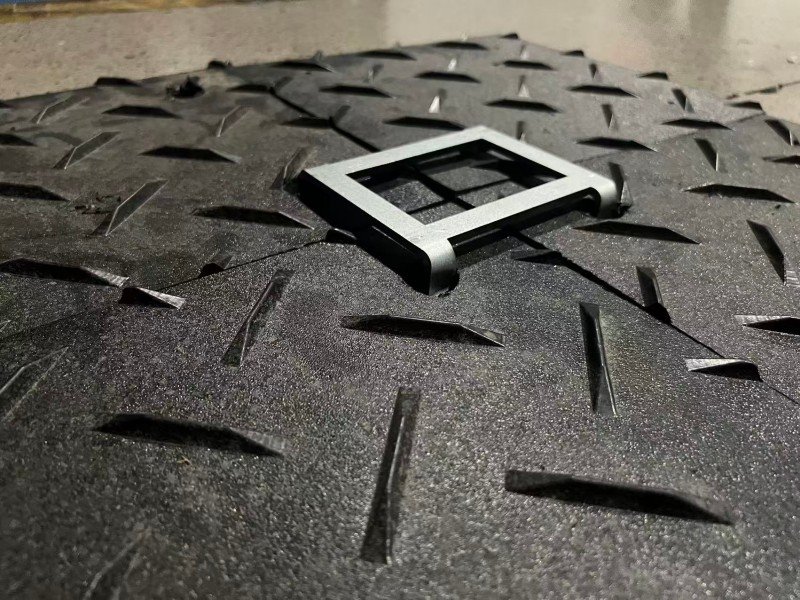
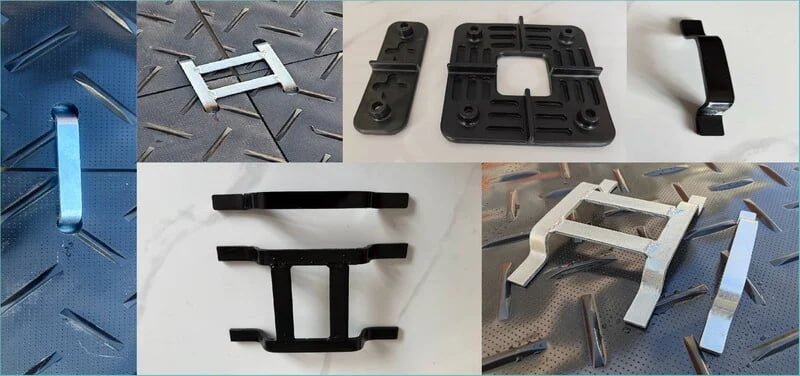
2-way connectors join two mats along one seam. 4-way connectors lock four mat corners together at one junction.
This article will help you decide where to use 2-way connectors, where 4-way connectors are needed, and how to build a temporary parking lot that stays aligned under vehicle traffic, soft ground, rain, and repeated use.
The Simple Difference
The basic difference is easy:
| Connector Type | What It Connects | Best Use |
|---|---|---|
| 2-way connector | Two mats along one seam | Straight lanes, edges, simple mat rows |
| 4-way connector | Four mat corners at one junction | Parking fields, drive aisles, turning areas |
| Mixed layout | 2-way + 4-way together | Most temporary parking lots |
For a small straight access lane, 2-way connectors may be enough.
For a wider temporary parking lot where vehicles enter, turn, reverse, stop, and park, 4-way connectors become much more important.
At BKM, we do not choose connectors only by accessory type. We look at how the parking area will actually be used.
The key factors are:
- ground condition
- traffic direction
- parking layout
- entrance and exit points
- turning zones
- weather
- vehicle weight
- installation time
- whether the mats stay down for one day or several days
Why Connectors Matter More in Parking Lots Than Straight Roads
A temporary parking lot is not the same as a temporary road.
On a straight road, vehicles mainly move forward.
In a parking area, vehicles do much more:
- enter from an angle
- slow down
- brake
- reverse
- steer sharply
- park with one tire near a seam
- turn around at the end of aisles
- leave under wet or muddy conditions
These movements create side force, not only downward load.
Loose mats may work for very light, controlled use. But in a parking lot, loose mats can quickly become a problem.
Common problems include:
| Problem | What Usually Causes It |
|---|---|
| Mats separate | Braking, reversing, or turning |
| Corners lift | Vehicles crossing loose junctions |
| Tires catch edges | Open seams or shifted panels |
| Mud squeezes through joints | Soft wet ground under movement |
| Rows move out of line | Only seams are connected, not junctions |
| Pedestrian trip points appear | Raised corners or uneven gaps |
| Parking area looks messy | Repeated traffic without enough connection |
You do not want a parking lot that looks fine in the morning but starts opening seams before lunchtime.
Connectors help the mats behave more like one temporary surface instead of many loose panels.
How 2-Way Connectors Work
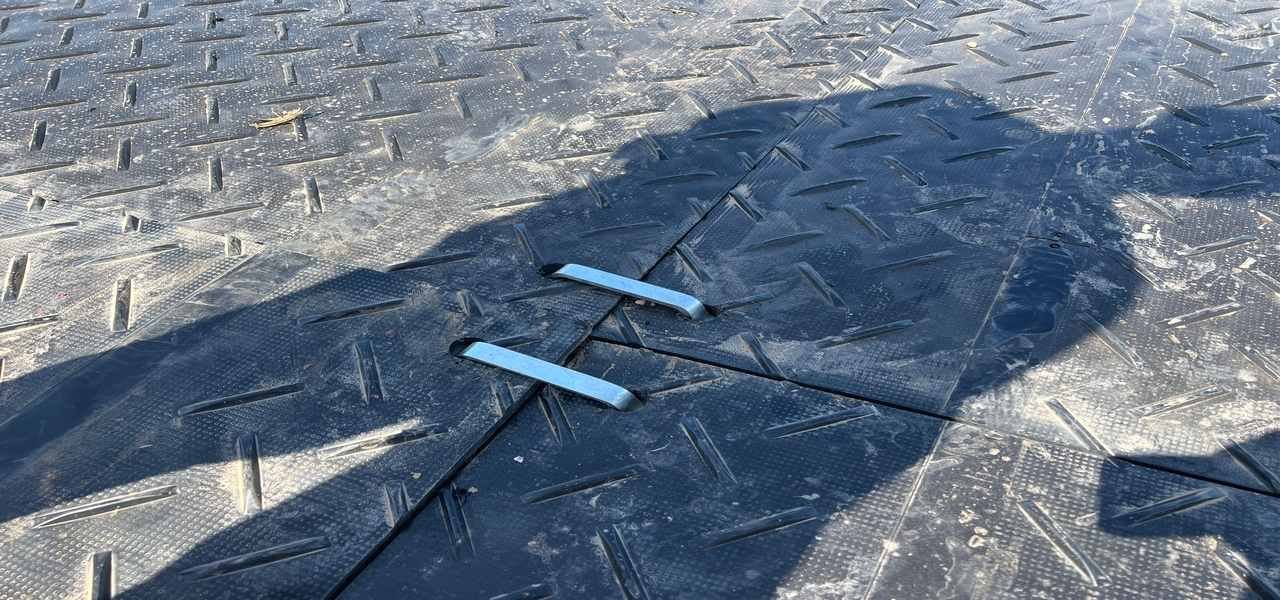
A 2-way connector links two mats together along one seam.
It is commonly used where one mat edge meets another mat edge.
For example, if you lay mats end to end to build a straight access lane, 2-way connectors can hold each mat to the next one.
In a temporary parking lot, 2-way connectors are useful for:
- straight driving lanes
- outer edges of the mat layout
- simple mat rows
- low-traffic areas
- places where only two mats meet
- short private parking setups
- narrow access routes into the parking area
The advantage is speed.
2-way connectors are simple, fast to install, and useful for linear layouts.
The limitation is that they mainly control one seam. They do not control a four-corner junction the same way a 4-way connector does.
If vehicles turn across the layout, 2-way connectors alone may not hold the full parking field tightly enough.
How 4-Way Connectors Work
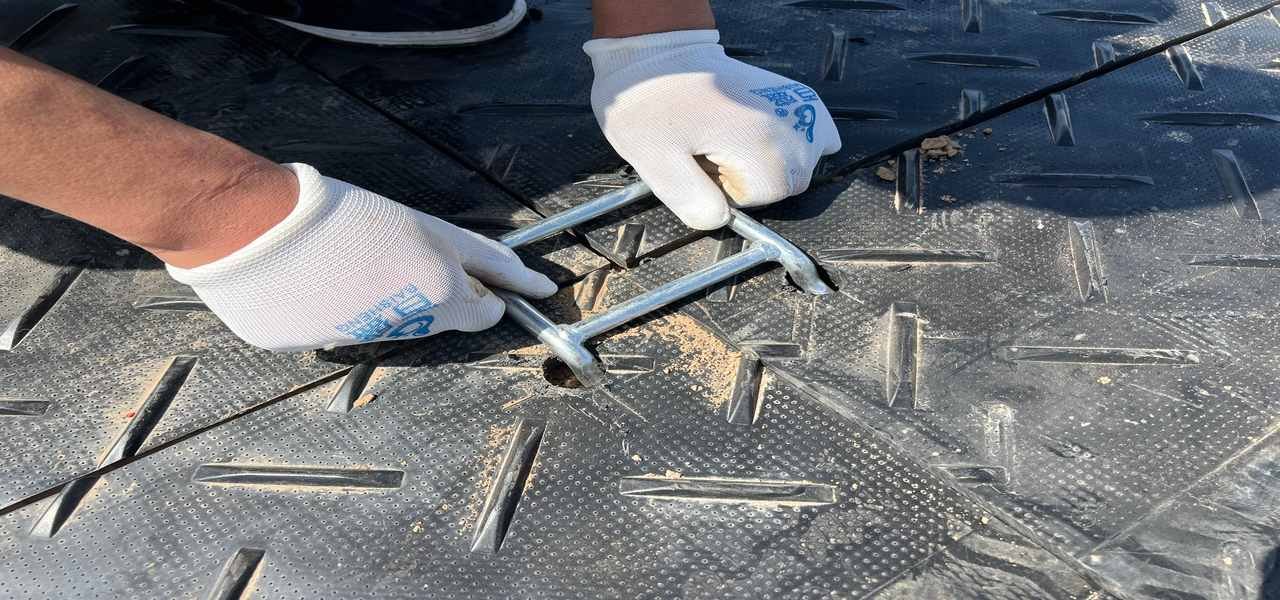
A 4-way connector locks four mat corners together where four mats meet.
This is especially useful in wide mat fields.
In a temporary parking lot, 4-way connectors are useful for:
- main parking fields
- internal mat grids
- drive aisles
- parking rows
- turning zones
- event parking
- muddy ground
- wet grass
- longer installations
- public parking areas
- areas with repeated vehicle movement
The advantage is stability.
A 4-way connector controls the junction, reduces corner movement, keeps the grid tighter, and helps the mat field stay square.
For a parking lot, this matters because vehicles rarely move in one perfect straight line.
Drivers turn, reverse, correct their angle, and sometimes brake with one wheel on one mat and another wheel on the next mat.
That is where 4-way connectors do the work 2-way connectors cannot fully do.
Real-Use Difference: Seam Control vs Grid Control
The real difference is not only “two mats vs four mats.”
The real difference is movement control.
| Connector Type | What It Controls | What It Does Not Control Well |
|---|---|---|
| 2-way connector | One seam between two mats | Diagonal movement across a large grid |
| 4-way connector | One four-corner junction | Outer edges where only two mats meet |
| No connector | Nothing fixed | Separation, edge lift, and mat drift |
A 2-way connector helps hold a row together.
A 4-way connector helps hold a field together.
For a temporary parking lot, the field matters more than a single row.
If you only use 2-way connectors in a large parking area, the rows may stay partly connected, but the whole surface can still move diagonally or open at corners.
If you use 4-way connectors at the main junctions, the parking lot behaves more like one connected surface.
Connector Priority by Parking Area
Not every part of a parking lot carries the same risk.
Some areas need stronger connection because vehicles pass over them repeatedly or change direction there.
| Parking Area | Movement Risk | Connector Priority |
|---|---|---|
| Main entrance | Very high | 4-way where possible, strong connection plan |
| Exit lane | High | 4-way and 2-way mixed |
| Internal drive aisle | High | 4-way at grid points |
| Turning zone | Very high | 4-way strongly recommended |
| Parking bay | Medium to high | 4-way in main field |
| Outer edge | Medium | 2-way connectors |
| Straight access lane | Medium | 2-way may be enough |
| Pedestrian path | Medium | 2-way or 4-way depending on layout |
| Wet grass section | High | More 4-way connectors |
| Muddy section | Very high | Strong connection plan |
| Firm dry corner with light use | Low to medium | Fewer connectors may be acceptable |
For BKM temporary parking layouts, I would connect the high-stress zones first: entrances, exits, drive aisles, turning areas, and muddy sections.
That is where movement usually starts.
Which Connector Should You Use?
For most temporary parking lots, BKM usually recommends using both connector types.
Use 2-way connectors where only two mats meet.
Use 4-way connectors where four mat corners meet.
That mixed approach is more practical than forcing one connector type everywhere.
| Layout Situation | Recommended Connector |
|---|---|
| Two mats meet along one seam | 2-way connector |
| Four mat corners meet | 4-way connector |
| Straight single-lane route | 2-way connector |
| Wide parking field | 4-way connectors in the grid |
| Turning area | 4-way connectors strongly recommended |
| Outer edge of parking area | 2-way connectors |
| Soft ground under traffic | More 4-way connectors |
| Public event parking | 4-way in main field, 2-way on edges |
| Short private parking on firm dry ground | 2-way may be enough in simple areas |
A simple rule works well:
If two mats meet, use a 2-way connector. If four mat corners meet, use a 4-way connector. If cars turn, brake, or reverse there, do not leave the joint loose.
Where 4-Way Connectors Matter Most
You do not need to overthink every seam, but some areas deserve attention before the first vehicle enters.
Entrance Lanes
The entrance is one of the highest-stress zones.
Cars slow down, turn in, brake, and sometimes queue at the same point.
If entrance mats move, the rest of the parking area can start failing from the front.
Drive Aisles
Drive aisles see repeated traffic.
A mat under one parked car is different from a mat crossed by hundreds of cars.
Use 4-way connectors at internal grid points in the drive aisle whenever possible.
Turning Areas
Turning creates side force.
If vehicles turn on loose mats over grass or mud, panels can shift quickly.
For turning areas, do not rely only on connectors. Add more mats and make the turning pad wider.
Parking Bays
Parking bays may also need 4-way connectors if cars reverse into them.
Low-speed steering can push mat corners apart, especially on soft ground.
Wet or Muddy Sections
Wet ground reduces friction under the mats.
Once mud starts moving up through seams, the parking surface becomes harder to maintain.
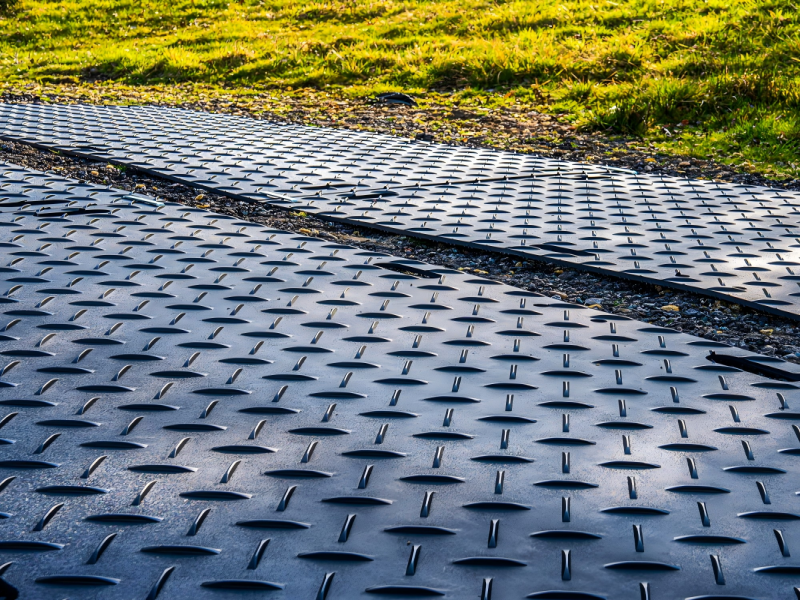
For wet or muddy areas, start with a stronger connector plan. It is much easier to prevent mat movement than to fix a shifted layout after traffic begins.
When 2-Way Connectors May Be Enough
2-way connectors may be enough when the layout is narrow, straight, dry, and lightly used.
They can work well for:
- simple access lanes
- outer edges
- short private parking routes
- low-traffic mat rows
- areas where only two mats meet
- firm dry ground
- controlled vehicle movement
For example, if you build a narrow lane from a road to a small parking patch, 2-way connectors may be practical along the route.
But for event parking, public parking, construction parking, wet-weather parking, or large temporary overflow parking, 2-way connectors alone are usually not enough for the main parking field.
Ground Condition Changes the Connector Plan
Connector choice depends heavily on the ground underneath.
On firm dry ground, mats naturally stay more stable.
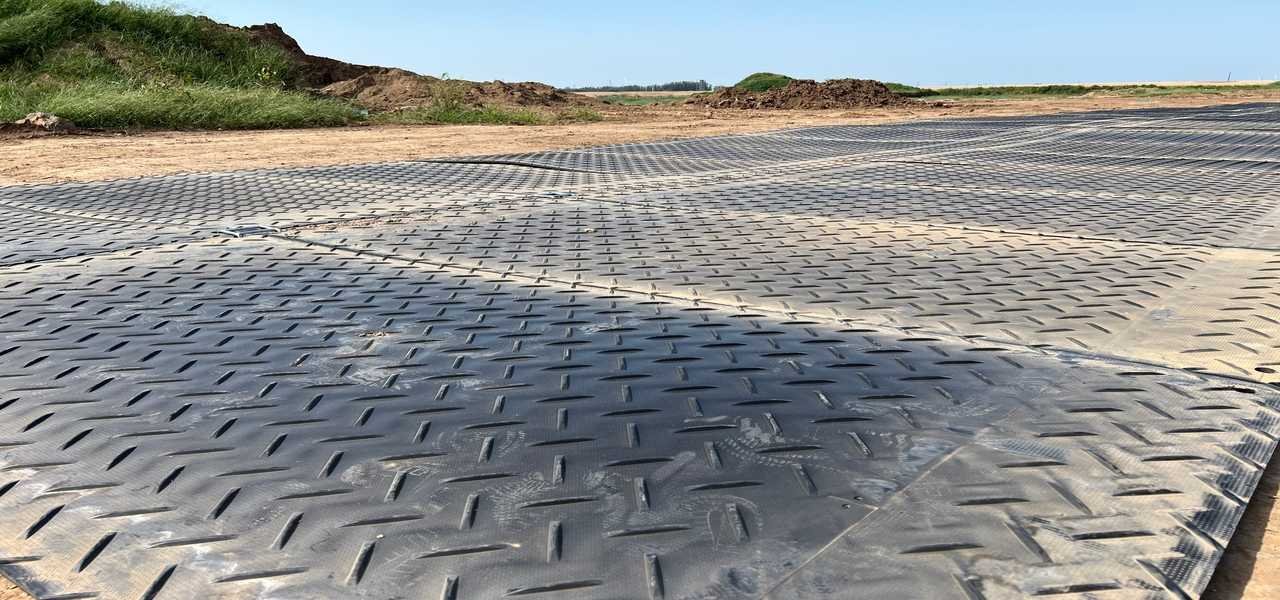
On wet grass, mud, soft soil, clay, sand, or uneven ground, mats are more likely to move because friction under the mat is lower.
Wet soil is also more vulnerable to compaction and rutting under repeated vehicle traffic.1
That means a connector plan that works on dry ground may fail after rain.
| Ground Condition | Movement Risk | Practical Connector Plan |
|---|---|---|
| Dry firm soil | Low to medium | 2-way on simple seams, 4-way in main grid |
| Dry grass | Medium | Connect traffic lanes and turns |
| Wet grass | High | More 4-way connectors and wider layout |
| Mud | Very high | Strong 4-way grid and frequent inspection |
| Clay | High when wet | Strong connection and controlled traffic |
| Sand | Medium to high | Wider layout and more connected joints |
| Uneven ground | High | Prepare ground before laying mats |
| Gravel | Medium | Connect high-traffic and turning areas |
If rain is possible, design the parking lot for the wet version of the site, not only the dry version.
That one decision can prevent a lot of cleanup later.
Do Connectors Increase Load Capacity?
Not directly.
A connector does not turn a light-duty mat into a heavy-duty mat.
It does not change the mat thickness, material strength, or ground support underneath.
What it does is help mats work together.
Connectors reduce:
- separation
- edge lifting
- gaps
- corner movement
- panel drift
- exposed weak edges
This improves the performance of the temporary parking surface, but it does not replace correct mat selection.
If your parking lot will handle passenger cars and light vans, a standard ground protection mat may be enough depending on ground condition.
If the site will handle trucks, buses, RVs, forklifts, or heavy equipment, check mat type, thickness, ground support, route width, and turning zones carefully.
Temporary Parking Layout Example
If you are using 4 ft × 8 ft ground protection mats, two rows side by side can create an 8 ft wide lane.
For parking areas, you usually need more than a narrow lane because drivers need room to enter, correct steering, reverse, and park.
A practical parking layout usually includes:
| Parking Element | Layout Focus |
|---|---|
| Entry lane | Wide enough for turning in |
| Drive aisle | Connected grid, not loose rows |
| Parking bay | Mat field should cover tire positions |
| Turning end | Wider pad with 4-way connectors |
| Pedestrian path | Stable surface with controlled edges |
| Exit lane | Strong connection where cars accelerate |
| Soft spot | Extra mats before traffic begins |
| Overflow area | Wider layout to allow imperfect driving |
Do not design the layout too tightly.
Drivers do not follow perfect lines, especially in rain, low light, crowded event traffic, or muddy conditions.
The mat layout should leave room for real human driving, not only neat drawings.
Public Parking Needs Extra Stability
If the temporary parking lot is for public use, connection becomes more important.
Public walking surfaces should stay stable, firm, and slip-resistant. Open gaps, lifted corners, and uneven mat edges can create problems for pedestrians, carts, strollers, and wheelchairs.2
For public temporary parking, pay attention to:
- entrance walking paths
- payment or ticket areas
- pedestrian routes to the venue
- ADA access routes
- cart routes
- wet zones
- lighting conditions
- mat edges near walking traffic
The parking lot is not only for cars.
People will walk across it, often while distracted, carrying bags, pushing carts, or moving in groups.
A stable mat layout protects both the ground and the people using it.
How to Plan Connectors Before Installation
Start with a simple drawing.
Mark:
- entrance
- exit
- drive aisles
- parking bays
- turning zones
- pedestrian routes
- wet areas
- soft ground
- slopes
- high-traffic sections
Then choose connector type by location.
A practical installation plan looks like this:
| Installation Step | Action |
|---|---|
| 1 | Walk the site and identify soft or wet areas |
| 2 | Mark entrance, exit, aisles, bays, and pedestrian paths |
| 3 | Start laying mats from firm ground |
| 4 | Use 4-way connectors in the main parking grid |
| 5 | Use 2-way connectors along edges and simple seams |
| 6 | Add more connection at entrances, turns, and drive aisles |
| 7 | Widen turning areas before cars arrive |
| 8 | Test with slow vehicle movement |
| 9 | Inspect after the first group of vehicles |
| 10 | Keep spare connectors on site |
Do not wait until mats have already shifted.
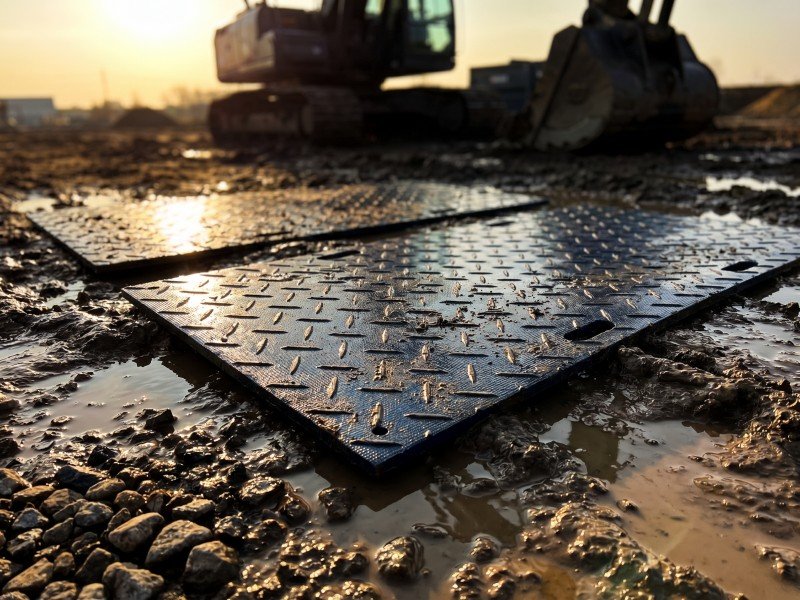
Once cars have pushed mats out of alignment and mud starts coming through the seams, the layout is harder to fix.
BKM Practical Recommendation
If you are building a temporary parking lot, do not rely on loose mats unless the job is very small, dry, flat, and controlled.
For a practical BKM setup:
- use 4-way connectors in the main mat field
- use 2-way connectors along straight seams and edges
- add more connectors at entrances, turns, and drive aisles
- use a wider mat layout where vehicles turn or reverse
- check the layout after the first vehicles pass
- keep spare connectors on site
- do not let cars drive off the mat edge onto soft ground
- remove mud buildup before it spreads through seams
If your site is public, muddy, or used for more than one day, connectors are not optional in practice. They are part of making the temporary parking lot usable.
BKM can support HDPE ground protection mats with connector holes, 2-way and 4-way connector options, surface textures, hand holes, common sizes, custom dimensions, colors, logo marking, private-label needs, and export packaging.
BKM also provides connector systems for mat layouts. Other site accessories, such as ramps, hooks, storage racks, anchors, straps, or underlayment, can be prepared locally if your project requires them.
FAQ
What is the difference between 2-way and 4-way connectors?
A 2-way connector joins two mats along one seam. A 4-way connector locks four mat corners together where four mats meet.
Which connector is better for a temporary parking lot?
Most temporary parking lots need both. Use 4-way connectors in the main parking field and drive aisles. Use 2-way connectors along edges and simple seams.
Can I use only 2-way connectors?
For a narrow, straight, dry, low-traffic layout, yes. For wider parking areas, event parking, public parking, wet ground, or turning zones, 2-way connectors alone are usually not enough.
Do I need 4-way connectors for event parking?
Yes, they are strongly recommended in the main mat field, entrances, turning areas, and drive aisles. Event parking usually has repeated vehicle movement and unpredictable driving patterns.
Do connectors increase mat load capacity?
Not directly. Connectors do not change mat material strength or thickness. They help mats stay aligned and work as a connected surface.
Where should I use 4-way connectors first?
Start with entrances, internal drive aisles, turning zones, parking rows, muddy sections, and any place where cars brake, turn, or reverse.
Where should I use 2-way connectors?
Use 2-way connectors where only two mats meet, such as outer edges, simple seams, straight access lanes, and narrow routes.
Can I leave some mats unconnected?
Only in low-risk areas with firm dry ground and light controlled use. If the area has vehicles, mud, public access, turning, or repeated traffic, key joints should be connected.
Conclusion
2-way and 4-way connectors do different jobs in a temporary parking lot.
2-way connectors control simple seams between two mats. 4-way connectors control the grid junctions where four mat corners meet.
For a small straight access lane, 2-way connectors may be enough. For a real temporary parking lot with cars turning, braking, reversing, and parking, 4-way connectors are usually essential in the main mat field.
The safest and most practical setup is usually a mixed connector plan: 4-way connectors in the parking grid and high-traffic zones, 2-way connectors along edges and simple seams.
At BKM, the practical rule is simple: if vehicles will move in more than one direction, connect the mats like a parking field, not like a straight road.
References
Iowa State University Extension and Outreach. “How and Why to Avoid Soil Compaction.” https://crops.extension.iastate.edu/cropnews/2010/04/how-and-why-avoid-soil-compaction ↩
U.S. Access Board. “Chapter 3: Floor and Ground Surfaces.” https://www.access-board.gov/ada/guides/chapter-3-floor-and-ground-surfaces/ ↩