
 English
 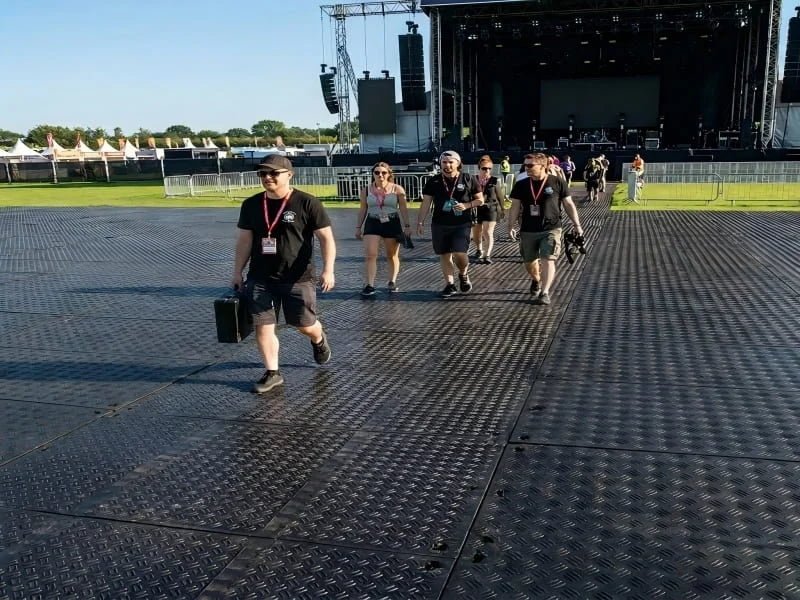 A mat can feel safe for walking but fail under cart traffic. It can also grip tires well but feel uncomfortable for guests. If your route carries both people and light vehicles, the texture must balance comfort, traction, and stability.
Are There “Pedestrian-Friendly” Mat Textures That Still Allow Light Vehicles to Pass?
Yes, you can use ground protection mats with pedestrian-friendly textures that still allow light vehicles to pass. But the surface design needs to be chosen carefully.
The best option is usually not a smooth mat. It is also not the most aggressive mud cleat. You need a middle ground: a texture that feels stable under foot and still gives enough grip for golf carts, utility carts, maintenance vehicles, light trailers, or small service vehicles.
Can One Mat Surface Work for Both Pedestrians and Light Vehicles?
Yes, but only if the surface is designed for mixed use.
A route used by event guests, workers, carts, golf carts, or small service vehicles cannot be judged by walking comfort alone. It also needs enough traction, mat thickness, connector support, and layout width for light rolling traffic.
This is where many mat choices go wrong. A smooth mat may look clean, but it can become slick when wet. A heavy mud cleat may look strong, but it can feel rough under foot and uncomfortable for carts, strollers, or wheelchairs.
For BKM projects, I normally separate mat surfaces into three groups: pedestrian surfaces, mixed-use surfaces, and vehicle traction surfaces.
If your route will be used by both people and light vehicles, choose a mixed-use texture—not a smooth sheet and not a heavy cleat designed only for equipment access.
How to Judge Whether a Texture Is Pedestrian-Friendly
When I look at a mixed-use mat, I do not start by asking whether the surface looks aggressive.
I start with the traffic.
Will people walk on it all day? Will carts cross it only during setup? Will light vehicles turn on it, or only drive straight? Is the route public, private, temporary, or part of an event entrance?
Then I look at the walking surface. A pedestrian route should feel stable, firm, and reasonably slip-resistant. The U.S. Access Board explains that accessible floor and ground surfaces must be stable, firm, and slip resistant, and that rough or uneven surfaces can be difficult for wheeled mobility aids.1
After that, I look at vehicle use. Light vehicles do not need a construction-road cleat in every case, but they still need enough mat thickness, surface grip, connector support, and route width.
This is the decision framework I would use:
| Question | Why It Matters |
|---|---|
| Will the route be public or private? | Public routes need more attention to comfort, edges, gaps, and walking safety. |
| Will carts, strollers, or wheelchairs use the route? | Texture height and surface smoothness become more important. |
| Will light vehicles drive straight or turn? | Turning creates side force and can shift mats. |
| Is the ground firm, wet, or soft? | Soft ground can make a pedestrian-friendly mat unstable under wheels. |
| Will the route stay down for hours or days? | Turf stress, cleaning, and inspection become more important. |
| Do you need connectors or edge transitions? | Gaps and raised edges can create walking and rolling problems. |
What “Pedestrian-Friendly” Really Means
A pedestrian-friendly mat should not feel like a smooth plastic sheet. It should also not feel like a rough construction cleat.
It should feel firm under foot, give enough grip for normal shoes and boots, and avoid high sharp lugs that can make walking uncomfortable.
For public routes, you also need to think about carts, dollies, wheelchairs, strollers, and event guests. A mat that feels fine to a worker in boots may not feel acceptable to a guest in dress shoes.
Accessible route guidance uses a 36-inch continuous clear width as a basic reference and requires surfaces on accessible routes to be firm, stable, and slip resistant.2
For your project, that does not mean every temporary route becomes an ADA route. But it does give you a useful way to think about walking comfort, route width, and surface stability.
A good pedestrian-friendly texture usually has:
- a low to medium raised pattern
- rounded surface details
- enough grip for wet shoes
- modest height to reduce walking discomfort
- enough body strength for light rolling loads
- controlled gaps between connected mats
If the texture is too smooth, it may become slippery. If the texture is too aggressive, it may become uncomfortable or difficult for small wheels.
Can Light Vehicles Pass Over Pedestrian-Friendly Mats?
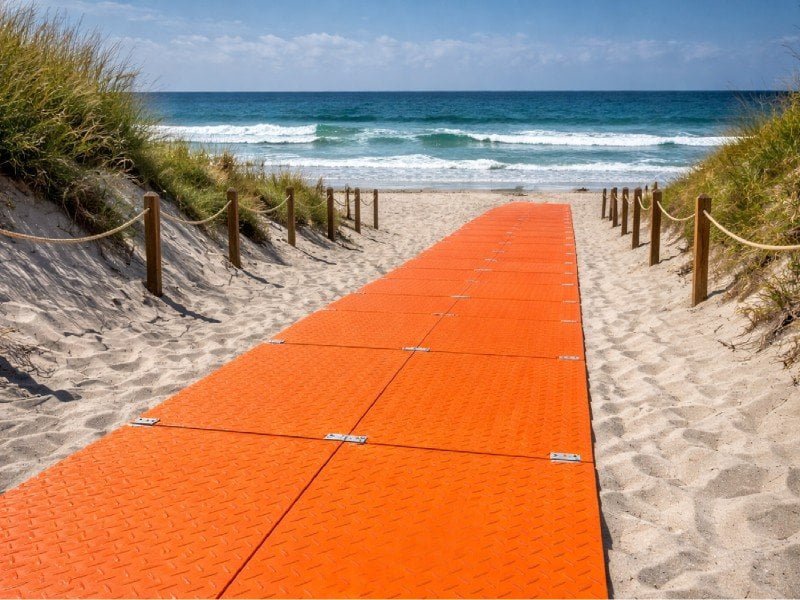
Yes, if the mat is designed for mixed use and the ground underneath is stable enough.
A golf cart, UTV, small mower, maintenance cart, light service buggy, or hand-pushed equipment cart does not create the same pressure as a dump truck, skid steer, forklift, or crane support area.
But “light vehicle” does not mean “no risk.”
A small vehicle can still shift mats, damage turf, or push panels out of place if the route is wet, narrow, sloped, or unconnected.
If the vehicle turns sharply, brakes, or drives repeatedly over the same section, the mat needs more than a walking-friendly top surface. It needs enough thickness, connector support, and layout width.
OSHA’s walking-working surface standard also reminds us that a surface should support the maximum intended load and be maintained free of hazards such as loose boards, sharp objects, spills, snow, and ice.3
For mixed-use routes, I would think the same way: do not design only for feet if wheels will also use the path.
Best Texture Types for Pedestrians and Light Vehicles
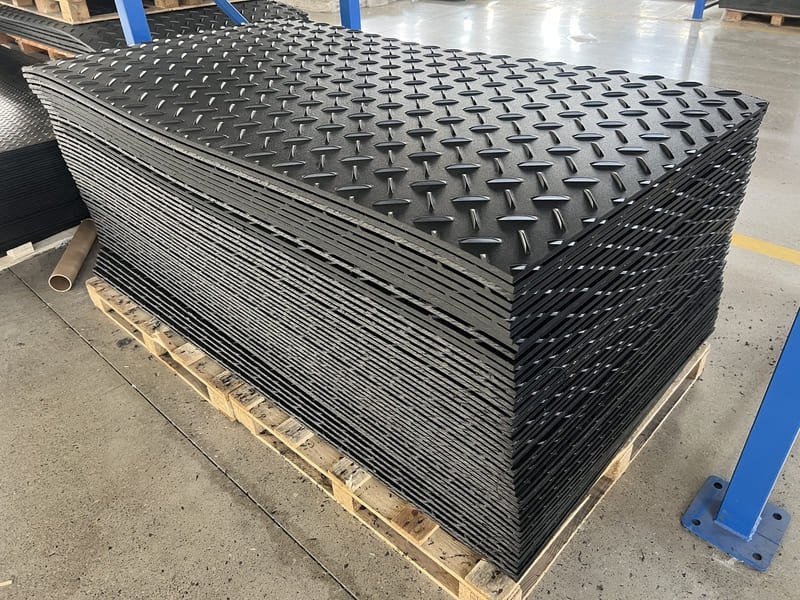
A low-profile diamond texture is often a practical choice.
It gives multi-directional grip without feeling too aggressive. Shoes can walk over it comfortably, and light vehicle tires can still find enough contact for slow movement.
A fine crosshatch texture can also work well for pedestrian routes. It gives more grip than a smooth sheet and can feel comfortable for walking.
This type is useful for event walkways, temporary pedestrian paths, and light cart access.
A small raised button or coin texture can work when the main use is walking. But it may not be the best choice for muddy light vehicle routes because mud can fill small patterns quickly.
A shallow ribbed texture can work when movement is mostly straight. It may be less balanced when vehicles turn or when people walk from different directions.
A dual-sided mat is often the best compromise. One side can have a lower pedestrian-friendly texture, while the other side can have stronger traction for vehicles.
This gives you more flexibility when one project needs a walkway and the next project needs a light access route.
How High Should the Texture Be?
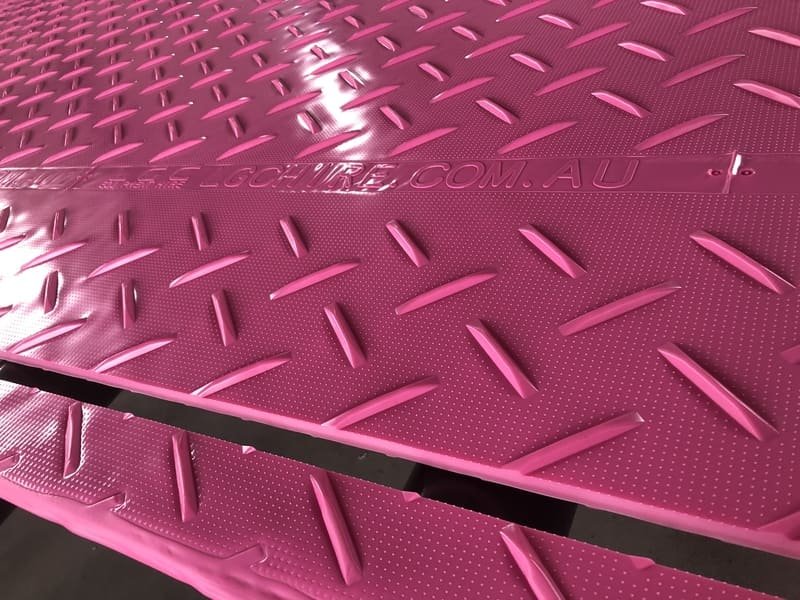
Texture height should stay modest when people are the main traffic.
As a practical BKM guide:
| Main Use | Practical Texture Direction |
|---|---|
| Pedestrian routes | Low-profile texture, often around 1.5–3 mm |
| Mixed pedestrians and light vehicles | Medium mixed-use texture, often around 2–4 mm |
| Muddy vehicle access | Higher traction cleat, often around 4–6 mm |
| Public event walkway | Rounded low texture with controlled gaps |
| Cart or stroller route | Low texture, stable seams, and smooth transitions |
The mistake is choosing the tallest cleat because it looks stronger.
A high aggressive cleat may help in mud, but it can be uncomfortable for pedestrians, harder for carts, less suitable for wheelchairs, and more difficult to clean after events.
If your main traffic is people, do not overbuild the texture like a construction road.
If your main traffic is vehicles in mud, do not underbuild the texture like an event walkway.
The Ground Under the Mat Still Matters
A pedestrian-friendly mat can support light vehicles only when the surface underneath is suitable.
Firm grass, compacted soil, asphalt, concrete, and prepared event surfaces are easier to manage. Deep mud, soft clay, saturated turf, loose sand, and uneven soil are different problems.
The mat spreads load, but it does not replace the ground underneath.
Iowa State University Extension notes that wet soil and traffic increase compaction risk, especially when equipment operates under less-than-ideal moisture conditions.4
That matters even for light vehicles. A route that is stable in dry weather may become unstable after rain and repeated cart traffic.
If the subgrade is weak, you may need a thicker mat, a wider layout, connectors, or a different access system.
This is especially important for event grounds. A pedestrian flooring route may allow light vehicle use over stable ground, but it should not be treated like a heavy-duty construction road.
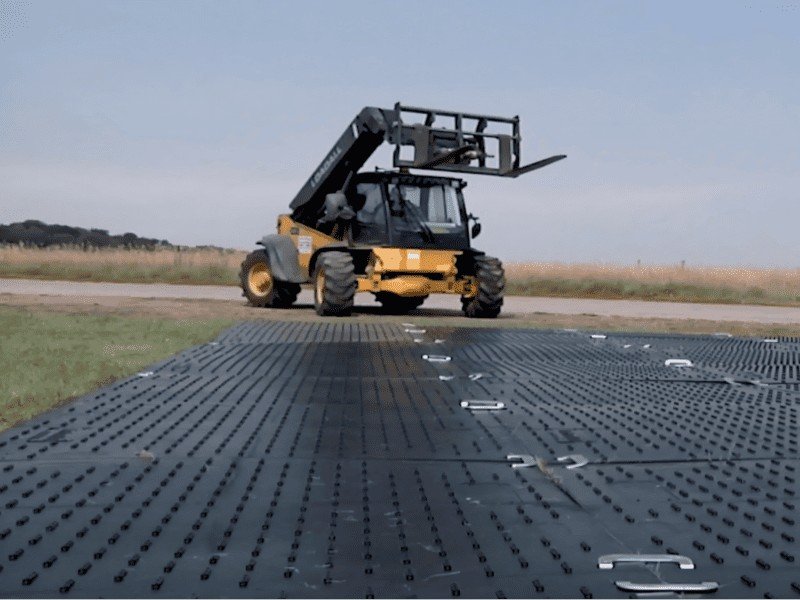
Use Connectors for Mixed Traffic
If your mats will be used by both pedestrians and light vehicles, connectors are usually worth using.
People walking across mats may not create heavy load, but repeated foot traffic can open gaps. Light vehicles can push mats out of alignment, especially when they turn or brake.
Once gaps appear, the route becomes less comfortable and less safe.
Connectors help the mats behave as one continuous route. They reduce separation, edge lifting, and uneven transitions.
For BKM mixed-use routes, I normally recommend connectors in these areas:
- entrances
- turning points
- slopes
- wet grass
- cart routes
- event aisles
- public walkways
- wheelchair or stroller routes
If the route is very short, flat, dry, and private, you may not need connectors everywhere.
But if a shifted mat would create a trip point or a wheel problem, connect the mats before the route opens.
Do Not Forget Edges and Transitions
For pedestrian-friendly matting, the edge is as important as the surface.
A good texture does not help if people trip at the mat edge. For public walkways, event entrances, temporary flooring, or accessibility routes, edge transitions need special attention.
The U.S. Access Board notes that changes in level on accessible floor and ground surfaces have limits, and larger changes need treatment such as beveling, ramps, or curb ramps.1
For your mat route, this means you should check the height difference where people enter or leave the mats.
If the mat sits high above grass, soil, or pavers, use an edge transition where needed. If the mat sinks into soft ground during use, inspect the edge again.
For a light vehicle route, transitions also reduce impact when the vehicle enters the mat road. This helps protect mat edges and reduces shifting.
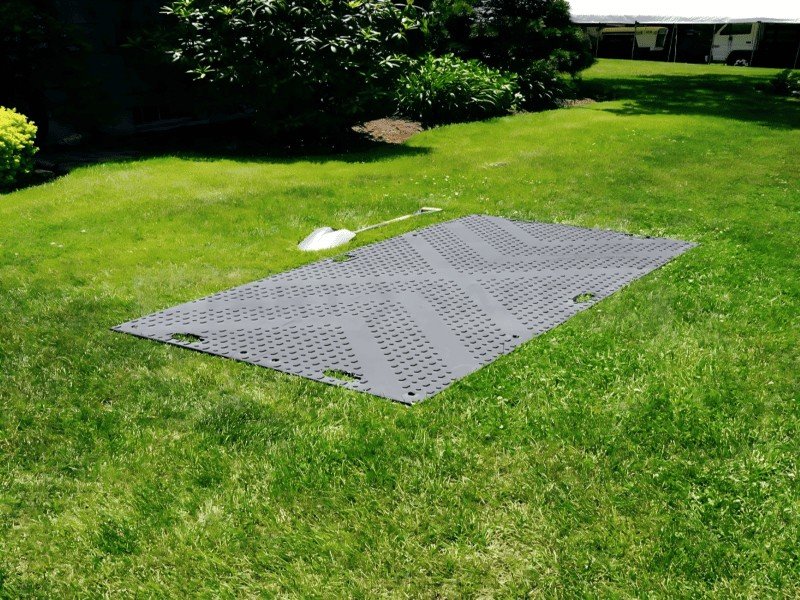
Turf Protection Needs More Than a Comfortable Texture
If the mats will be used over grass, texture is only one part of the decision.
Turf can be damaged by traffic wear and soil compaction. UMass Amherst explains that traffic stress includes immediate plant wear and longer-term compaction stress at the root zone level.5
This matters for event lawns, stadium turf, parks, golf course edges, hotel lawns, schools, and landscaped properties.
A pedestrian-friendly texture can reduce walking discomfort, but it does not remove turf risk. The mat still blocks light and changes moisture and heat around the grass.
If the route carries light vehicles, turf stress can increase quickly at turning points, entrances, and repeated cart paths.
For valuable turf, plan the route before traffic begins. Remove the mats as soon as practical, and inspect high-pressure areas first.
Where Pedestrian-Friendly Mixed-Use Mats Work Best
Pedestrian-friendly mixed-use mats are a good choice when your site needs walking comfort plus occasional light vehicle access.
They are useful for outdoor festivals, stadium turf protection, wedding lawns, parks, public spaces, golf course service access, temporary walkways, residential landscaping, maintenance cart routes, school and campus events, hotel lawns, and light utility access.
In these places, the surface must not feel too industrial.
Guests, workers, and staff need to walk comfortably. At the same time, carts, small service vehicles, and maintenance equipment may still need to pass.
That is where a mixed-use texture makes sense.
EPA’s construction stormwater BMP guidance also supports the broader idea that temporary site movement should be planned and controlled before it creates erosion, sediment, or access problems.6
Even if your project is not a construction site, the same thinking applies: plan the route before people and vehicles create their own path.
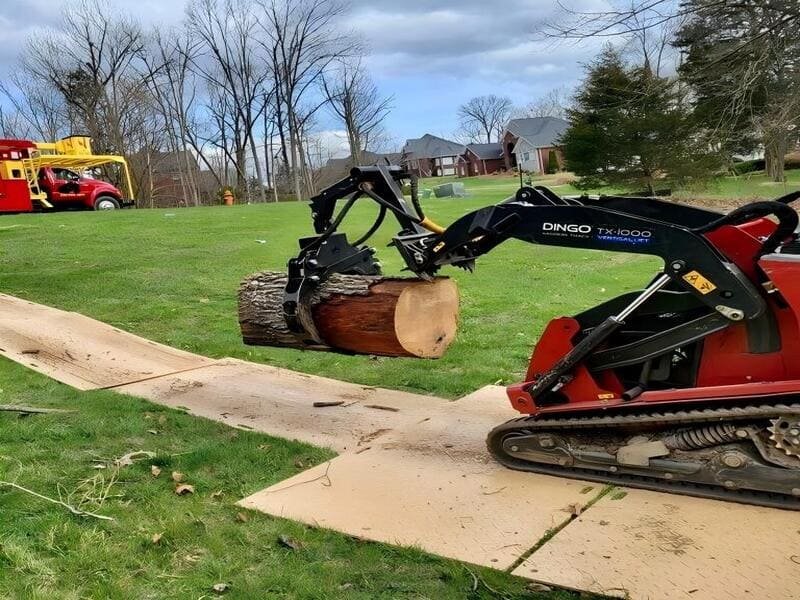
When You Should Not Use a Pedestrian-Friendly Texture
A pedestrian-friendly texture is not the best choice for every situation.
If your route has deep mud, repeated skid steer traffic, loaded forklifts, dump trucks, heavy equipment, sharp turning, steep slopes, or construction entrance traffic, you should move to a stronger vehicle traction surface.
A shallow texture may feel nice for walking, but it can fill with clay and lose grip under tires. It can also wear faster if the wrong equipment uses it repeatedly.
For muddy vehicle routes, choose a raised diamond, cleated, or more aggressive traction profile.
For audience walkways, choose a lower pedestrian texture.
If both uses exist on the same site, separate the routes or use a dual-sided mat where practical.
How BKM Helps You Choose the Right Texture
If your route must serve pedestrians and light vehicles, BKM normally recommends a medium-profile mixed-use texture.
For event and public walking areas, choose a stable, firm, slip-resistant texture with rounded surface details.
For occasional light vehicles, make sure the mat has enough body thickness, enough stiffness, connector holes, and a layout wide enough for safe movement.
A practical setup is:
- use low-profile diamond or fine crosshatch texture for pedestrian comfort
- use connectors where carts or light vehicles pass
- use edge transitions at public access points
- use a wider route than the vehicle width
- add extra mats at turning points
- avoid sharp turns on shallow pedestrian textures
- move to a heavier cleat profile if the site is muddy or vehicle use becomes frequent
BKM can support surface texture options, common sizes, custom dimensions, color choices, hand holes, connector holes, logo marking, private-label needs, and export packaging.
BKM provides connector systems for mat layouts. Other site accessories, such as ramps, hooks, storage racks, straps, anchors, or underlayment, can be sourced locally if your project requires them.
The best surface is not the smoothest surface, and it is not the roughest surface. It is the surface that matches your real traffic.
FAQ
Are smooth mats better for pedestrians?
Not usually. Smooth plastic can become slippery when wet. A low-profile textured surface is usually better because it gives shoes and carts more grip without feeling too rough.
Can pedestrian-friendly mats handle golf carts?
Yes, if the mat is designed for mixed use and the ground underneath is stable. Use connectors and a wide enough route if the carts will turn or pass repeatedly.
Can wheelchairs and strollers use textured mats?
They can use the right type of low-profile texture. Avoid high aggressive cleats on public routes. For accessibility, keep the route firm, stable, connected, and free from raised gaps.
What texture is best for both people and light vehicles?
A low-profile diamond, fine crosshatch, or medium mixed-use texture is usually a good balance. It gives walking comfort while still allowing slow light vehicle movement.
Can the same mat be used for pedestrians and skid steers?
Sometimes, but it is not ideal. Skid steers create strong turning force and usually need a more aggressive vehicle mat layout. For pedestrian routes, use a lower texture. For skid steers, use stronger traction mats.
Do pedestrian-friendly mats work in mud?
They work in light mud or damp grass, but deep mud may fill the texture and reduce grip. For muddy vehicle access, use a more open and aggressive cleat pattern.
Do I need connectors for pedestrian-friendly mats?
For public routes, carts, wheelchairs, light vehicles, wet ground, or repeated use, yes. Connectors help reduce gaps and movement.
Should I use edge ramps or transition pieces?
For public routes, event entrances, wheelchairs, strollers, carts, or any route with a noticeable height change, yes. Smooth transitions help reduce trip points and make the route easier to use.
Conclusion
Pedestrian-friendly ground mat textures can still allow light vehicles to pass when the surface, mat thickness, connector system, and layout are chosen correctly.
For mixed-use routes, BKM usually recommends a low to medium-profile slip-resistant texture, such as low diamond, fine crosshatch, or a dual-sided mat design.
This gives you a safer walking surface while still supporting light carts, golf carts, maintenance vehicles, and small service equipment under controlled conditions.
Do not choose by texture alone. Look at your traffic, ground condition, turning movement, route width, connector plan, edge transitions, and public safety needs.
If people and light vehicles share the same route, the mat should feel comfortable under foot, stable under wheels, and controlled as one connected temporary surface.
References
U.S. Access Board. “Chapter 3: Floor and Ground Surfaces.” https://www.access-board.gov/ada/guides/chapter-3-floor-and-ground-surfaces/ ↩
U.S. Access Board. “Chapter 4: Accessible Routes.” https://www.access-board.gov/ada/guides/chapter-4-accessible-routes/ ↩
Occupational Safety and Health Administration. “1910.22 - General Requirements.” https://www.osha.gov/laws-regs/regulations/standardnumber/1910/1910.22 ↩
Iowa State University Extension and Outreach. “How and Why to Avoid Soil Compaction.” https://crops.extension.iastate.edu/cropnews/2010/04/how-and-why-avoid-soil-compaction ↩
UMass Amherst Center for Agriculture, Food, and the Environment. “Traffic Stress & Turf Cultivation.” https://www.umass.edu/agriculture-food-environment/turf/best-management-practices-bmps-for-lawn-landscape-turf/9-traffic-stress-turf-cultivation ↩
U.S. Environmental Protection Agency. “National Menu of Best Management Practices (BMPs) for Stormwater-Construction.” https://www.epa.gov/npdes/national-menu-best-management-practices-bmps-stormwater-construction ↩