
 English
 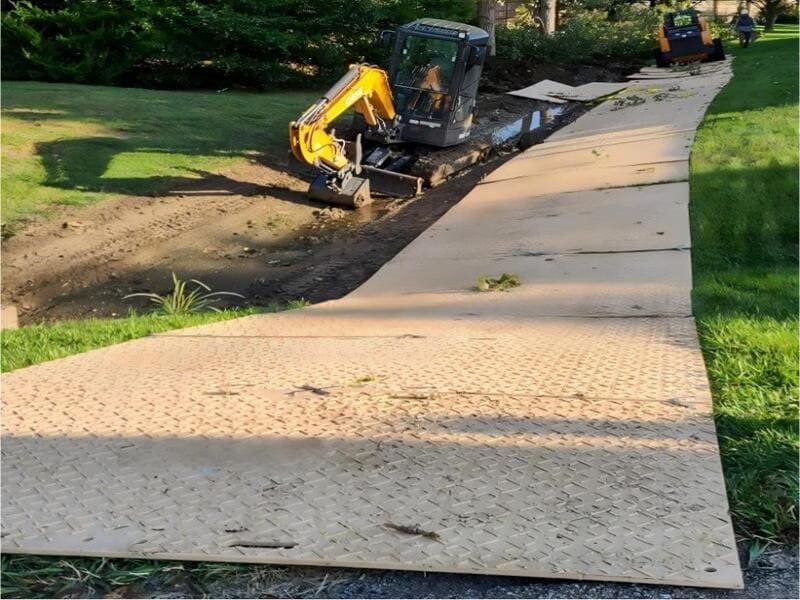 You need ground protection mats when soft ground starts costing you money: stuck machines, damaged turf, muddy access, delayed work, and repair bills after the job.
Ground protection mats are temporary panels laid over grass, mud, soil, sand, gravel, or finished surfaces. They help create a usable route for workers, carts, vehicles, or equipment while reducing rutting, sinking, and surface damage.
For BKM, this product is not just a plastic board. It is a temporary access solution that should match your ground, load, traffic pattern, route layout, and reuse plan.
Why You Are Really Looking for Ground Protection Mats
You may be preparing for construction access, event flooring, landscaping work, utility service, temporary parking, farm access, or a rental mat business. The surface problem may look different, but the real pressure is usually the same.
You need to keep work moving without destroying the ground underneath. Wet or compacted soil can lose structure faster under repeated traffic, so the route should be planned before damage starts.1
If you rent mats to others, the mat must survive repeated handling. It cannot only look good in the first shipment.
If you are buying for events, the mat must help people move safely across grass or wet ground. Walking surfaces should stay clear, stable, and free from hazards that create slip or trip risks.2
If you are buying for construction or landscaping, access usually matters most. If machines cannot reach the work area, the schedule becomes harder to control.
So the first question is not “What is a ground protection mat?” The better question is: what problem must this mat solve for your project or your market?
Start with the Job, Not the Mat Size
I often see people start with size because size feels easy to compare. A common request is 4 ft × 8 ft, and that size can be a practical starting point.
But two 4 ft × 8 ft mats can be completely different products. One may be lighter, thinner, smoother, softer, or made with a different material mix.
The mat size tells you coverage. It does not tell you strength, traction, handling, or service life.
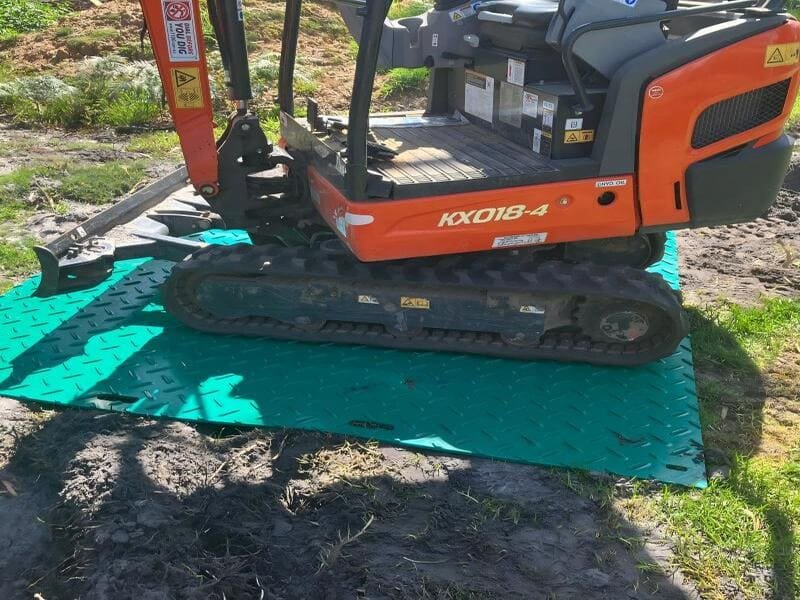
Before you compare prices, check what will pass over the mats. Pedestrians, carts, pickup trucks, forklifts, skid steers, tractors, and loaded trucks do not create the same pressure.
Then look at the ground. Firm turf, wet clay, loose sand, gravel, compacted soil, and premium pavers all need different thinking. Soil compaction becomes worse when ground is wet and traffic is repeated.1
Finally, look at the movement. A straight route is easier than a turning area, parking bay, loading point, or repeated equipment path.
A common size can be useful. But a correct mat is chosen by the job.
What a Ground Protection Mat Actually Is
A ground protection mat is a temporary panel used to protect the surface and create access. It is not a permanent road, and it is not ordinary plastic sheeting.
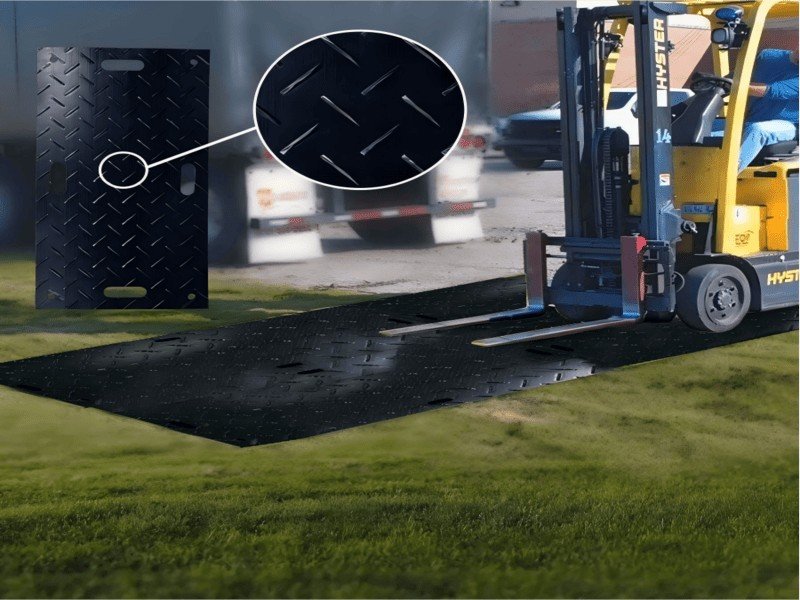
A proper mat usually has enough body thickness, a traction surface, hand holes, connector holes, and material strength for outdoor work. These details decide whether the mat is practical on a real site.
Most mats are rectangular because rectangular panels are easy to connect into roads, walkways, parking areas, and work pads. The 4 ft × 8 ft size is common because it gives useful coverage and can still be handled by a small crew.
Smaller sizes can work better for side yards, gardens, narrow gates, or light pedestrian routes. Larger or thicker mats may be better for repeated vehicle access.
The mat works by spreading pressure over a larger area. That helps reduce direct ground damage from wheels, tracks, boots, and carts, especially where soil is vulnerable to compaction.1
But the mat still needs support underneath. It should not be treated as a bridge over trenches, holes, septic fields, or unsupported voids because trench and excavation conditions require proper protective systems.3
The Details That Separate a Real Mat from a Plastic Sheet
A ground protection mat may look simple, but the details matter in daily use.
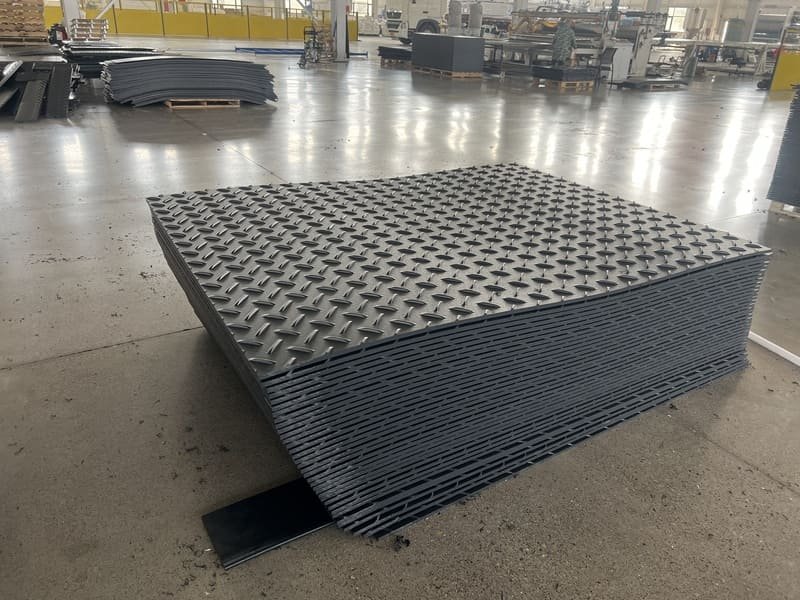
The surface texture affects grip. A diamond pattern, raised tread, or cleat profile gives better contact than a smooth plastic sheet.
That matters when the route is wet, muddy, sloped, or used by vehicles that turn. A smooth surface may look clean, but it can become less practical outdoors.
If people will walk across the route, the surface also needs to stay firm, stable, and reasonably slip-resistant. OSHA requires walking-working surfaces to be kept in a clean, orderly, and sanitary condition, and maintained free of hazards such as sharp objects, loose boards, corrosion, leaks, spills, snow, and ice.2
Hand holes affect labor. They help your crew lift, drag, align, remove, and stack the mats.
This detail becomes important after rain or mud. A heavy mat without a useful hand hole can slow down removal and cleaning.
Connector holes affect stability. They allow multiple mats to be joined into a temporary road, parking area, walkway, or work platform.
For vehicle routes, BKM normally recommends connectors. Loose mats can shift when vehicles turn, brake, reverse, or pass repeatedly.
Some mats may also have anchor holes. These can help in sloped, windy, or movement-prone areas.
BKM mainly provides ground protection mats and connector systems. Other tools, such as pulling hooks, racks, straps, ramps, anchors, or underlayment, can be prepared locally when your site needs them.
Why HDPE Is Common for Ground Protection Mats
Most professional ground protection mats are made from HDPE, or high-density polyethylene. BKM uses HDPE because it gives a practical balance of toughness, moisture resistance, impact resistance, and handling efficiency.4
Outdoor mats face rain, mud, stones, grass, gravel, pressure washing, stacking, transport, and repeated loading. The material must stay usable after more than one job.
Plywood can work for a very light, short, dry task. But once the site becomes wet, plywood may absorb water, warp, split, splinter, or become slippery.
HDPE does not behave like wood. Typical HDPE material data shows why it is practical for removable outdoor products: it is much lighter than metal and has useful impact and mechanical performance for plastic sheet applications.4
This is important when you are buying in bulk. The cheapest first price may not be the lowest cost after ten jobs.
For rental or repeat-use work, material consistency becomes even more important. A mat must survive loading, unloading, muddy use, cleaning, storage, and another project.
Ground Protection Mats and Temporary Road Mats Are Related
Ground protection mats are the broader category. They protect surfaces and create access over grass, mud, soil, gravel, pavers, event grounds, and jobsite surfaces.
Temporary road mats describe one layout. When you connect mats in a continuous route for vehicles, you create a temporary road.
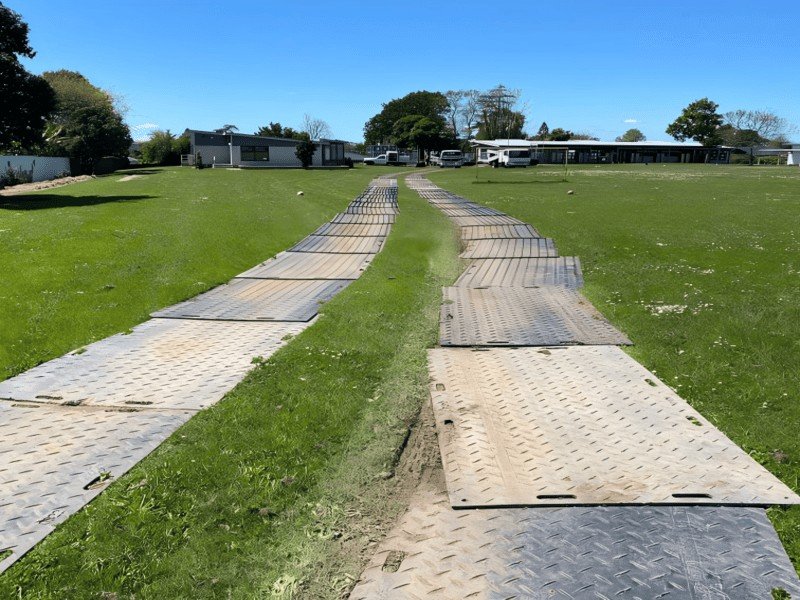
The same product can serve different purposes depending on how it is laid out. A short row may become a walkway.
A wider connected layout may become a temporary parking area. A reinforced route may become access for small equipment, trucks, or utility vehicles.
This is why layout matters as much as product choice. A mat does not work alone.
It works with the ground, the traffic, the route width, the connector plan, and the installation method.
Ground Protection Mats Are Not Outrigger Pads
A normal ground protection mat should not be used as a dedicated outrigger pad.
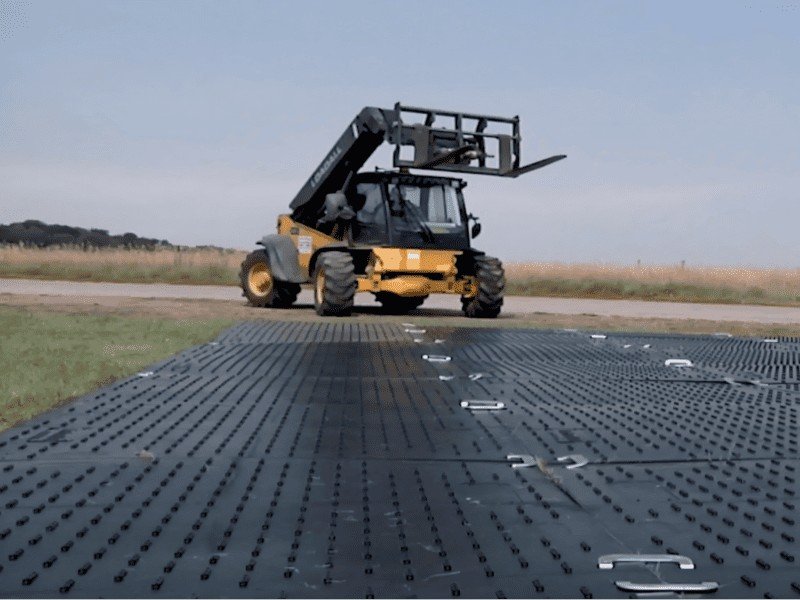
Ground protection mats are mainly for access routes, pedestrian movement, lawn protection, temporary parking, and vehicle travel.
Outrigger pads are used under crane outriggers, boom truck legs, concrete pump stabilizers, and other concentrated point loads.
A tire rolling across a mat spreads pressure differently from a crane leg pressing down on one small footprint. These are not the same load condition.
If your project involves crane legs or stabilizers, use dedicated outrigger pads or engineered support. Do not assume a ground protection mat can replace that product.
BKM can help you separate rolling-load applications from point-load applications during product selection. That distinction protects both the project and the product.
Where Ground Protection Mats Create Business Value
Ground protection mats are useful wherever temporary access must be created without permanently changing the site.
Construction teams use them at entrances, equipment routes, staging zones, and temporary work areas. The goal is to reduce mud, rutting, and access delays.
Landscaping and tree work teams use them to protect lawns, gardens, driveways, and finished properties. A clean exit matters when the property owner checks the site after the job.
Event teams use mats for walkways, temporary parking, vendor routes, backstage paths, and loading lanes. The goal is not only ground protection, but also safe movement and site appearance.
For turf areas, traffic pressure and compaction can weaken turf performance. Traffic stress is a known turf management issue, so event routes and repeated walking paths should be planned before the crowd or equipment arrives.5
Utility crews use mats to reach work areas across fields, road shoulders, soft soil, and uneven ground.
Farms use them for wet ground access and seasonal equipment movement. Public works teams may use them for parks, roadside jobs, temporary access, and emergency routes.
Rental businesses can use the same mat inventory across many markets. Construction, events, landscaping, farms, and utility access can all create repeat demand.
How to Judge the Right Mat Before You Ask for a Quote
A useful quote starts with your working conditions. It should not start and end with size.
You do not need the thickest mat every time. You need the mat that fits your ground, traffic, route, project duration, and reuse plan.
| What You Should Check | Why It Changes the Mat Specification |
|---|---|
| What will pass over the mats? | Pedestrians, carts, pickups, forklifts, skid steers, and trucks need different support. |
| What is the ground condition? | Grass, wet clay, sand, gravel, and compacted soil react differently under load.1 |
| Will traffic turn or drive straight? | Turning creates side force and makes connectors more important. |
| How long will mats stay down? | Long turf coverage needs attention to heat, moisture, and recovery.5 |
| Will the mats be reused or rented? | Reuse requires better handling, cleaning, stacking, packaging, and spare connectors. |
| Do you need brand or market packaging? | Logo marking, color choice, and private-label packaging can support resale. |
When BKM discusses a bulk order, we usually ask these questions before recommending thickness, weight, surface pattern, connector quantity, color, or packaging.
A quote should help you avoid the wrong mat. It should not only give you a lower number.
What Ground Protection Mats Can Do Well
Ground protection mats can reduce direct surface damage. They help control where people and vehicles move, instead of letting traffic spread across the site.
They can improve traction when the texture matches the ground condition. They also make cleanup easier because mud and rutting are more controlled.
They can help reduce delays when the weather changes. Wet ground becomes easier to manage when access routes are planned before the damage starts, because wet soil is more vulnerable to compaction and traffic damage.1
They can also lower the cost per project when the mats are reused. This matters for contractors, rental companies, event teams, and distributors.
The real value is not only the plastic material. The value is the reduced repair, better access, faster cleanup, and repeat use.
What Ground Protection Mats Cannot Do
Ground protection mats have limits, and it is better to be clear before you buy.
They should not be used as bridges over open trenches, holes, septic systems, or unsupported voids unless the product and installation are specifically engineered for that purpose. Trenching and excavation work has its own safety requirements and should not be treated as ordinary ground cover.3
They cannot make completely unstable soil safe by themselves. If the ground is deeply saturated, hollow, or poorly supported, you may need ground preparation or another access system.
They also cannot replace connectors when movement risk is high. If vehicles turn, brake, reverse, or pass repeatedly, loose mats may shift.
They cannot protect turf forever if left in place too long. Grass still needs light, air, moisture balance, and recovery time, especially where traffic stress already affects turf health.5
A good mat works as part of a system. Material, thickness, layout, connectors, ground condition, and installation all matter.
How BKM Supports Your Ground Protection Mat Order
BKM supplies HDPE ground protection mats for construction access, landscaping, event use, utility work, farming, temporary parking, and rental projects.
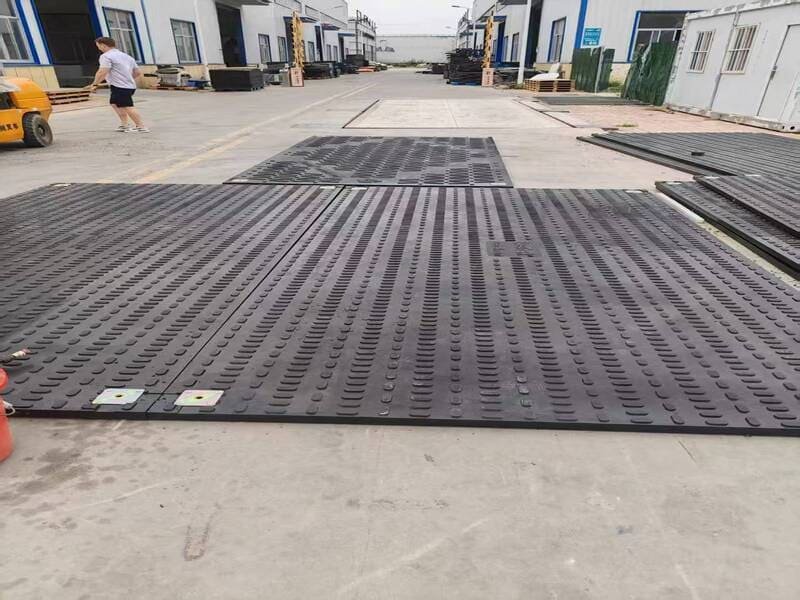
We can support common sizes and custom dimensions. We can also provide surface texture options, color choices, hand holes, connector holes, logo marking, private-label needs, and export packaging.
For bulk orders, packaging and loading matter. Mats must be stacked, wrapped, strapped, and loaded in a way that protects the panels and controls shipping efficiency.
For distributors and rental operations, we also consider repeat handling. Your mats need to be easy to count, clean, store, and send out again.
BKM provides connector systems for mat layouts. This is important for temporary roads, parking areas, turning zones, and repeated vehicle routes.
Other site tools can be sourced locally. Pulling hooks, racks, straps, ramps, anchors, and underlayment depend on local site habits and project rules.
The goal is not to push every accessory into your order. The goal is to help you specify the mat system correctly first.
FAQ
What are ground protection mats used for?
They are used to create temporary access and protect ground surfaces from traffic. Common uses include construction access, lawn protection, event walkways, temporary parking, utility routes, and equipment movement.
Are ground protection mats only for heavy equipment?
No. They can also be used for pedestrians, carts, light vehicles, outdoor events, landscaping, and rental projects. The mat specification should match the traffic type.
Can ground protection mats be used on grass?
Yes. They can reduce rutting and surface damage on grass. For valuable turf, do not leave solid mats down longer than necessary, especially in hot weather and repeated traffic areas.5
Can trucks drive on ground protection mats?
Yes, when the mat type, thickness, ground condition, route width, and connector plan are suitable. Truck routes need more planning than simple pedestrian walkways.
Are ground protection mats better than plywood?
For repeated outdoor use, yes. HDPE mats resist moisture better, do not splinter like plywood, and are easier to clean, stack, and reuse. HDPE’s material properties make it more suitable for repeatable outdoor plastic mat applications than wood sheets in wet use.4
Do ground protection mats need connectors?
For flat pedestrian use, connectors may not always be needed. For vehicles, slopes, turns, muddy ground, temporary roads, and repeated traffic, connectors are strongly recommended.
Can ground protection mats support rental business use?
Yes. For rental use, focus on durability, cleaning, stacking, labeling, connector supply, and packaging. The mat must survive repeated handling, not only one project.
Can ground protection mats replace steel road plates?
No. Steel road plates are used for trench coverage and structural bridging. HDPE ground protection mats are used for supported ground access and surface protection, not unsupported trench or excavation coverage.3
Conclusion
Ground protection mats are temporary panels used to protect surfaces and create access over grass, mud, soil, gravel, turf, and other outdoor ground conditions.
They are not ordinary plastic sheets. A proper mat needs the right material, thickness, traction surface, hand holes, connector holes, and layout plan.
If you are buying for construction, landscaping, events, utility access, farming, temporary parking, or rental use, do not choose only by size or price.
Choose by ground condition, traffic load, route design, reuse plan, packaging, and connector needs.
BKM helps you turn these details into a practical mat specification. The right ground protection mat does more than cover the ground.
It helps protect your schedule, your site, your resale value, and your long-term cost per use.
References
University of Missouri Extension. “Soil Compaction: The Silent Thief.” https://extension.missouri.edu/publications/g1630 ↩
Occupational Safety and Health Administration. “1910.22 - General Requirements.” https://www.osha.gov/laws-regs/regulations/standardnumber/1910/1910.22 ↩
Occupational Safety and Health Administration. “Trenching and Excavation.” https://www.osha.gov/shoring-trenching ↩
MatWeb. “Material Property Data: HDPE.” https://www.matweb.com/search/datasheet.aspx?MatGUID=fce23f90005d4fbe8e12a1bce53ebdc8 ↩
UMass Amherst Center for Agriculture, Food, and the Environment. “Traffic Stress & Turf Cultivation.” https://www.umass.edu/agriculture-food-environment/turf/best-management-practices-bmps-for-lawn-landscape-turf/9-traffic-stress-turf-cultivation ↩


Comments
Tyler Vance
Mar 18, 2025These composite mats are absolute beasts. Saved our rigs from sinking into the Texas mud last week, and cleanup was an absolute breeze.
Marc-André Roy
Apr 12, 2025We threw these mats right over the muskeg in freezing weather and they didn’t even flinch, eh? Super tough gear for the Canadian bush.
Austin Fowler
Sep 01, 2025Honestly, don’t even bother with cheap plastic sheets. If you’re moving heavy bucket trucks over soft clay, you need the real deal. We locked these BKM mats together with the connectors on a sloped job site last week, and they didn’t budge an inch. They make cleanup a breeze.