
 English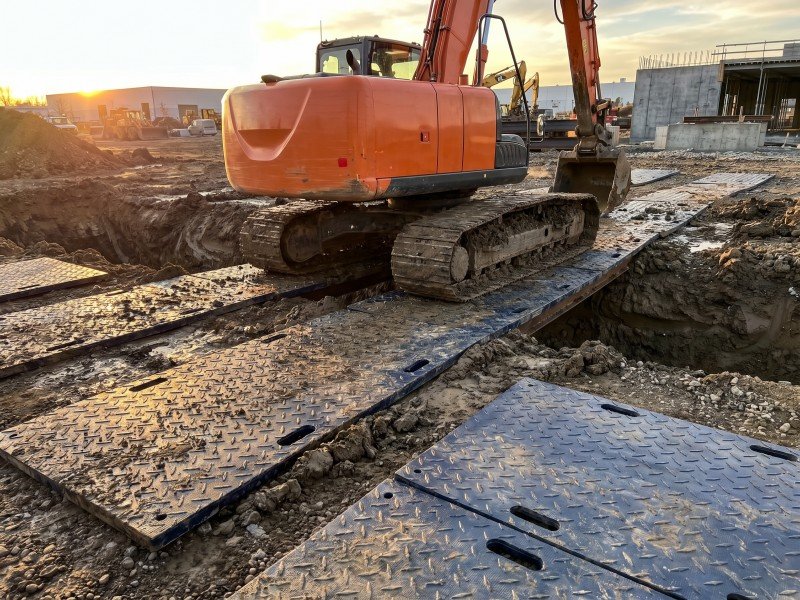
Are There Lightweight Ground Mats Designed Specifically for Mini-Excavators and Skid Steers?
A mini-excavator looks small until it pivots on wet turf. A skid steer looks compact until one turn pushes mats sideways. If you want lightweight mats, the question is not only how light they are—it is whether they can survive the machine.
Yes, there are lightweight ground protection mats designed for compact equipment such as mini-excavators, skid steers, compact track loaders, small loaders, trenchers, and landscaping machines.
But you should not choose them only because the product says “lightweight.” The mat still needs to match your machine weight, tire or track type, ground condition, turning pattern, route layout, and reuse plan.
Why You Are Looking for Lightweight Mats
You are probably not looking for lightweight mats because you want the thinnest product. You are looking for a mat your crew can actually move, while still protecting the surface under compact equipment.
Maybe you need to cross a customer’s lawn with a mini-excavator. Maybe a skid steer must bring material through a side yard. Maybe your crew needs to protect pavers, turf, asphalt edges, or a finished driveway.
The real problem is balance.
If the mat is too heavy, your crew loses time moving it. If the mat is too light or too flexible, it may shift, curl, sink, or fail under equipment movement.
For BKM applications, a good lightweight mat for compact equipment should do three things at the same time: protect the ground, stay manageable for your crew, and hold up under repeated machine movement.
How I Judge Lightweight Mats for Compact Equipment
When I recommend lightweight mats for mini-excavators or skid steers, I do not start with the word “lightweight.” I start with the machine and the site.
First, I look at the machine type. A tracked mini-excavator, wheeled skid steer, and compact track loader do not behave the same way on mats.
Then I look at movement. Will the machine only travel across the lawn, or will it dig, turn, carry material, reverse, and pivot in the same area?
I also look at the ground. Firm grass, wet clay, soft soil, gravel, pavers, and finished concrete all need different planning.
This is the basic framework I would use before recommending a mat:
| Question | Why It Matters |
|---|---|
| Is the machine wheeled or tracked? | Tires and tracks create different pressure and turning force. |
| Will the machine only travel or also work on the mats? | Digging, loading, and pivoting need wider support. |
| Is the ground wet, soft, or already compacted? | Wet soil is more vulnerable to compaction and rutting. |
| Will the route be straight or include turns? | Turning is where lightweight mats often shift. |
| Does the surface need protection after the job? | Turf, pavers, and finished driveways need extra care. |
| Will the mats be reused or rented? | Reuse requires better durability, cleaning, stacking, and connector planning. |
Compact Machines Are Not Always Light
A compact machine can still create serious ground pressure.
A mini-excavator, skid steer, or compact track loader may be smaller than a dump truck, but it can still damage turf, soft ground, pavers, asphalt edges, and finished driveways.
NIOSH treats skid-steer loaders as serious equipment used in agriculture, construction, and general industry for material handling and excavating. Its safety guidance also highlights the risks around operating and working near skid-steer loaders.1
That matters for mat selection. You are not protecting the ground from a garden cart. You are protecting it from a machine that can turn, dig, lift, carry, reverse, and pivot.
The pressure also changes by machine type.
A wheeled skid steer creates concentrated tire loads and strong sideways force when it turns. A compact track loader spreads weight better, but its tracks can still scrub turf and push mats during pivot turns.
A mini-excavator spreads weight through tracks, but when it turns, digs, swings, or uses the blade, the load is not perfectly even.
So the mat needs to match compact equipment behavior, not only compact equipment size.
What “Lightweight Ground Mat” Should Really Mean
For BKM, a lightweight ground mat is not a thin plastic sheet.
It is a mat that is strong enough for compact equipment but still practical for jobsite handling.
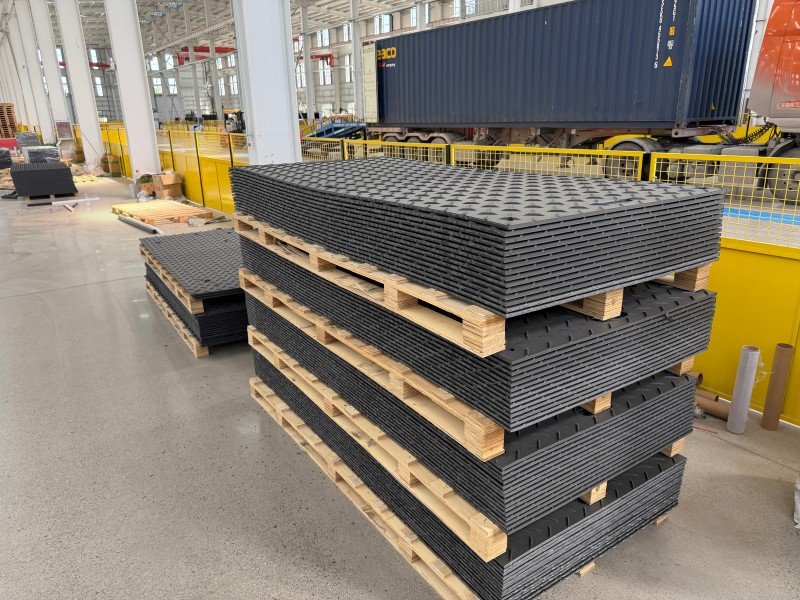
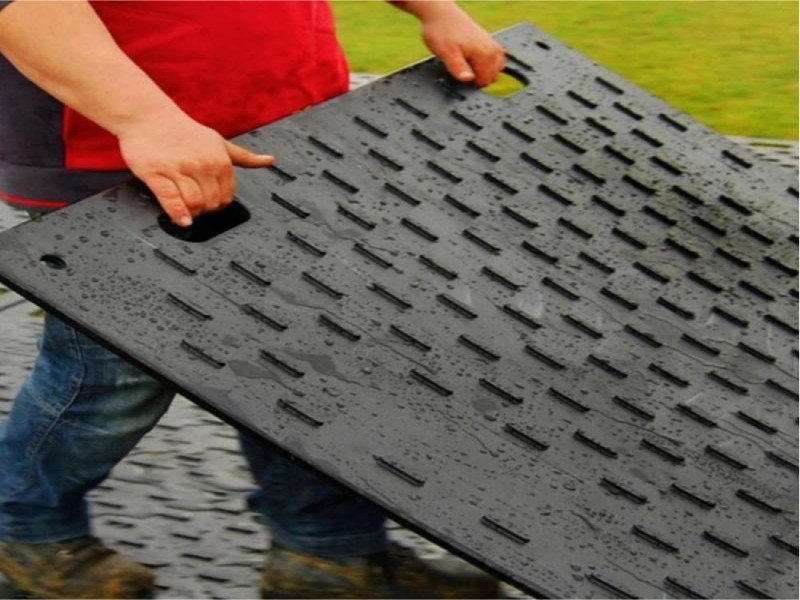
A common lightweight option is a 4 ft × 8 ft HDPE ground protection mat around 1/2 inch / 12.7 mm thick. This type of mat can often be handled by two workers and may include hand holes for lifting, dragging, loading, and stacking.
HDPE belongs to the polyolefin family. Plastics Europe describes HDPE as a material known for its large strength-to-density ratio, with typical density around 0.93 to 0.97 g/cm³.2
That is why HDPE is practical for many lightweight ground protection mats. It gives a useful balance between strength, moisture resistance, flexibility, and manageable weight.
For smaller crews, landscaping work, backyard access, and tight residential routes, smaller formats such as 3 ft × 8 ft, 3 ft × 6 ft, or 2 ft × 8 ft can also make sense.
The tradeoff is simple: larger mats cover more area and reduce seams, while smaller mats are easier to carry through gates, around houses, and across finished lawns.
Wet Ground Changes the Mat Decision
Ground condition is one of the biggest reasons lightweight mats either work well or disappoint you.
Firm grass is one situation. Wet clay, saturated soil, loose sand, and soft mud are completely different.
Iowa State University Extension notes that wet soils have higher compaction risk and that traffic should be minimized when soil moisture conditions increase compaction potential.3
For your site, this means you should not judge the mat only by machine size. You also need to judge the ground that supports the mat.
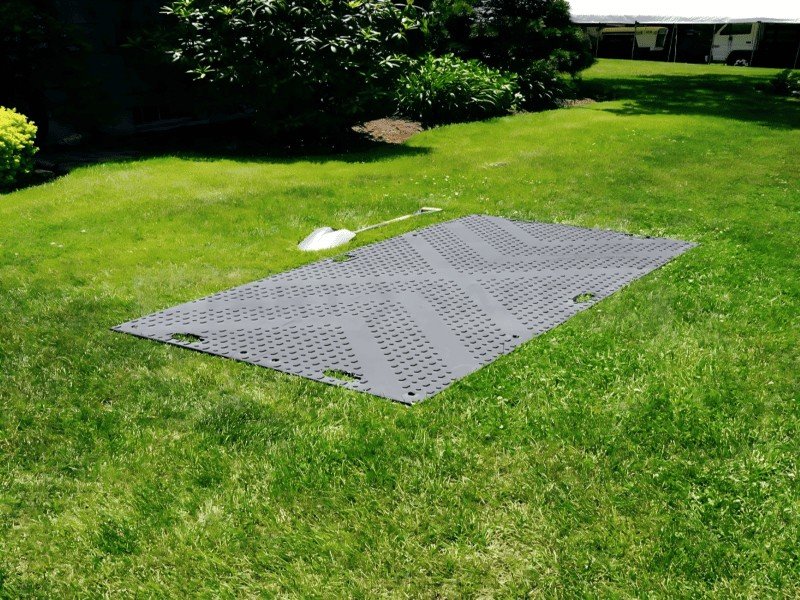
A lightweight mat may work well on firm turf for a short crossing. The same mat may need a wider layout, connectors, or heavier specification on wet clay.
If the ground is deeply waterlogged, hollow, or unsupported, a lightweight mat is not a magic fix. You may need ground preparation, wider coverage, or a different temporary access system.
What Makes a Mat Suitable for Mini-Excavators
A mini-excavator mat should handle tracked movement, turning, digging position, and blade contact.
For mini-excavators, BKM normally looks at machine weight, track width, ground softness, turning radius, route length, and whether the machine will dig from the mats.
If the mini-excavator is only crossing a lawn to reach the work area, lightweight HDPE mats may be enough.
If it will sit in one place and dig, pull, swing, or load material, you may need a wider working pad and possibly heavier mats.
For turf protection, do not let the excavator pivot repeatedly in one spot on a narrow mat line. Pivot turns can tear grass, shift mats, and stress connector points.
A practical setup is a 4 ft or 8 ft wide access route leading to a larger working area.
If the excavator must turn, create a pad instead of forcing the turn on a single row.
What Makes a Mat Suitable for Skid Steers
Skid steers are harder on mats than many people expect.
The reason is turning. A skid steer does not turn like a normal vehicle. It skids one side against the other, which creates side force on the mat surface and edges.
NIOSH skid-steer loader guidance is mainly about safety, but it also reminds us that these compact machines are powerful work equipment, not light-duty lawn machines.1
For wheeled skid steers, you need a mat with strong traction and enough stiffness to spread tire load.
For compact track loaders, you need a mat that can handle track movement and turning pressure without shifting too much.
For BKM skid steer applications, we usually recommend a raised traction surface, a wider route than the machine width, connectors for repeated traffic, extra mats at turning areas, and heavier-duty mats if the ground is soft or the machine is loaded.
If you use only one narrow row of mats, the operator has little room to correct the machine.
If one tire or track runs off the mat edge, the ground can rut quickly. For skid steers, an 8 ft wide route is often more practical than a tight single-track path, especially on lawns, mud, or soft soil.
Lightweight Does Not Mean Light-Duty
This is an important point.
A lightweight mat should be easy enough to handle, but it should not be so thin that it folds, curls, or sinks under compact equipment.
If the mat is too flexible, it may follow the rut instead of spreading the load.
For BKM, lightweight compact equipment mats should still have HDPE or a suitable composite material, controlled thickness, a traction surface, hand holes, connector holes when needed, enough stiffness for vehicle access, and enough flexibility to follow normal ground variation.
If the product feels like a thin sheet, it may be useful for pedestrian protection or light garden work. It should not be treated as a proper access mat for skid steers or mini-excavators.
Recommended Mat Thickness
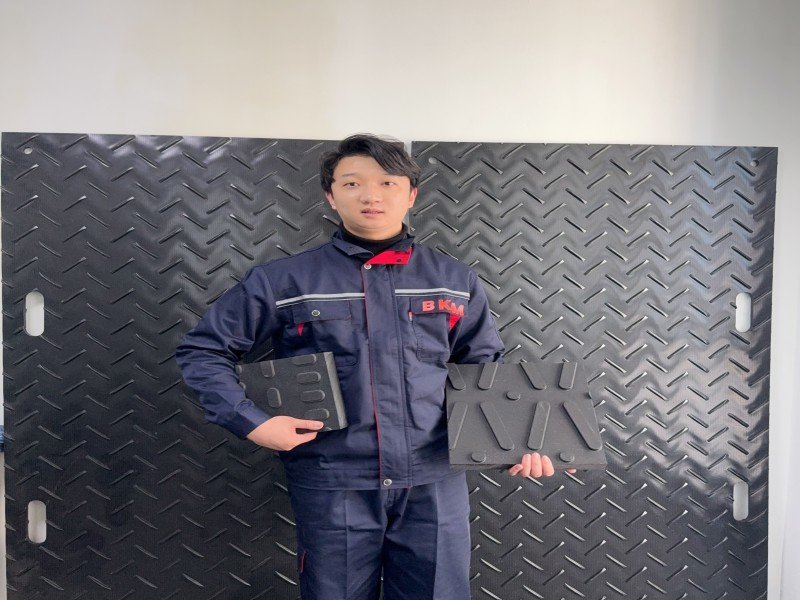
For light residential landscaping, small mini-excavators, compact garden machines, or short access routes, 1/2 inch / 12.7 mm HDPE mats are often a practical starting point.
For repeated skid steer traffic, loaded buckets, muddy ground, soft clay, or commercial rental use, you may need 3/4 inch or a heavier-duty mat design.
But I would not choose only by thickness.
A well-designed 1/2 inch mat may perform better than a poorly made thicker sheet. Material quality, surface pattern, connector design, and ground support all matter.
For very poor ground, deep mud, slopes, or repeated heavy turning, the answer may not be only thicker mats. You may also need better route layout, wider coverage, connectors, base preparation, or a different temporary access system.
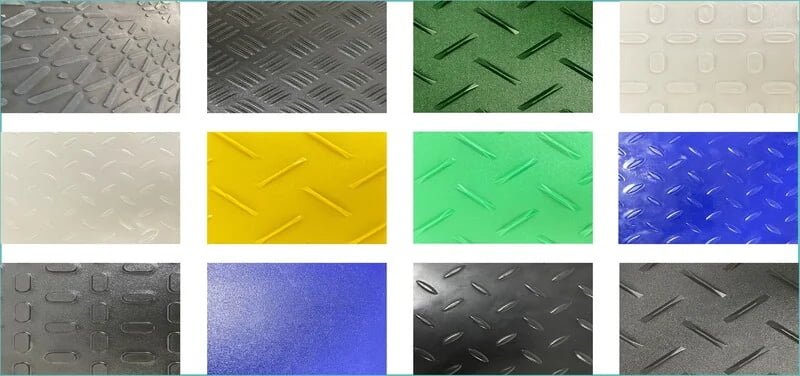
Best Surface Pattern for Compact Equipment
For mini-excavators and skid steers, the mat surface should provide traction without becoming too aggressive for turf or finished surfaces.
For muddy access, a raised diamond or cleated surface usually works well. It gives tires and rubber tracks more bite and helps reduce sliding.
If people also walk across the route, the surface needs to be stable and reasonable for foot traffic.
OSHA’s walking-working surface standard requires walking-working surfaces to be maintained free of hazards such as loose boards, sharp or protruding objects, leaks, spills, snow, and ice. It also requires walking-working surfaces to support the maximum intended load.4
For your mat route, that means surface texture and load support both matter.
For premium driveways, pavers, or finished hardscape, the concern is different. You need to protect the surface from scratches. In that case, clean the surface first and consider using a protective layer under the mats.
For mixed use, a dual-sided mat can be useful. One side can provide stronger traction for equipment, while the other side can be smoother or more pedestrian-friendly.
When Connectors Are Needed
If the mats are used only for a short straight crossing, connectors may not always be necessary.
But if you use mini-excavators or skid steers repeatedly, BKM recommends connectors.
Connectors help keep mats aligned. They reduce gaps, edge movement, and mat shifting.
This matters especially when equipment turns, brakes, reverses, or carries material.
For skid steers, connectors are even more important because turning creates side force. If the mats are loose, the machine may push them out of place.
Use connectors for muddy ground, slopes, turning zones, repeated equipment routes, rental use, and longer temporary roads.
For turning areas, connectors alone are not enough. You should also widen the mat layout.
Best Layout for Mini-Excavators and Skid Steers
The mat layout should follow how the equipment will actually move, not only the shortest distance.
For a small mini-excavator crossing a lawn, a single row of 4 ft wide mats may work if the route is straight and the operator is careful.
For skid steers, compact track loaders, or repeated traffic, an 8 ft wide route is usually better. This gives the operator more margin and keeps tires or tracks away from mat edges.
For working areas, make a pad instead of only a road. A practical work pad might be 8 ft × 16 ft, 12 ft × 16 ft, or larger depending on machine size and movement.
EPA construction stormwater BMP guidance highlights the need for site planning and construction-phase controls to manage sediment, access, and site disturbance.5
That same idea applies to mat layout. A route should be planned before compact equipment starts choosing its own path.
| Site Situation | Practical Mat Layout Advice |
|---|---|
| Straight lawn crossing | A single mat row may work for careful light use. |
| Skid steer access | Use a wider route, often 8 ft or more. |
| Digging or loading area | Build a working pad, not only a narrow path. |
| Turning zone | Add extra mats and use connectors. |
| Soft or wet ground | Increase coverage and reduce repeated turning. |
| Rental use | Choose a layout that is easy to install, count, clean, and repeat. |
For backyard access, plan the route before the machine arrives. Avoid tight turns, sprinkler heads, soft edges, paver borders, drain covers, and newly laid sod.
Turf Protection Needs Extra Care
If you are protecting grass, do not judge the mat only by equipment weight.
Turf can be damaged by wear and compaction stress. UMass Amherst explains that traffic can cause immediate wear injury and longer-term compaction stress at the root zone level.6
That matters for residential lawns, parks, schools, golf course edges, event venues, and landscaped properties.
Lightweight mats can help reduce rutting and direct machine contact. But they should still be removed properly.
Do not leave solid mats on valuable turf longer than necessary. Grass still needs light, air, moisture balance, and recovery time.
If the machine will turn or pivot, protect the turning zone with a wider pad. That is where turf usually suffers first.
Where Lightweight Mats Work Best
Lightweight ground mats are a good choice when you need compact equipment access for residential landscaping, tree service, backyard excavation, pool installation, fence work, utility trenching, garden renovation, temporary lawn access, small construction sites, event setup, and compact-machine rental use.
They are especially useful when your crew needs to install and remove mats quickly without heavy lifting equipment.
If you are protecting customer lawns, finished driveways, parks, schools, golf course edges, or event venues, lightweight mats can help you reduce rutting and cleanup while keeping handling manageable.
For rental use, the mat must also survive repeated loading, washing, counting, stacking, and return handling.
That is why I would not choose only the lightest product. I would choose the lightest product that still survives your real use.
When Lightweight Mats Are Not Enough
Lightweight mats are not the right answer for every job.
If your skid steer is carrying heavy loads all day, if the soil is saturated, if trucks will also use the route, or if the equipment will turn sharply in the same place, a lightweight mat may not be enough.
You may need heavier-duty mats if the ground is deep mud, the route has slopes, the machine will carry loaded buckets, vehicles will turn repeatedly, or the mats will be rented out for rough use.
If you need to support dump trucks, cranes, concrete pumps, or large loaders, do not use compact-equipment mats as a substitute for heavy-duty road mats or outrigger pads.
You should also avoid using normal lightweight mats as bridges over trenches, holes, septic fields, excavation edges, or unsupported voids.
OSHA’s trenching and excavation construction guidance highlights protective systems and safety controls for excavation work. Unsupported ground should not be treated as ordinary surface protection.7
If the ground underneath cannot support the load, the mat alone cannot solve the problem.
BKM Practical Recommendation
If you are choosing lightweight mats for mini-excavators and skid steers, start with the machine and the site.
Ask these questions first:
- What is the machine operating weight?
- Is it wheeled or tracked?
- Will it only travel, or will it dig and turn?
- Is the ground grass, mud, clay, gravel, pavers, or concrete?
- Will the route be straight or curved?
- How many times will the mats be reused?
- Does your crew need one-person or two-person handling?
For many compact equipment jobs, BKM would start with 1/2 inch HDPE lightweight ground mats for straight access and light to medium use.
For repeated skid steer traffic, soft ground, or rental use, we would move toward thicker mats, wider layout, and connectors.
BKM can support common mat sizes, custom dimensions, surface texture options, color choices, hand holes, connector holes, logo marking, private-label needs, and export packaging.
BKM also provides connector systems for mat layouts. Other site tools, such as pulling hooks, racks, straps, ramps, anchors, or underlayment, can be prepared locally when your project needs them.
The right solution is not simply the lightest mat. It is the lightest mat that can still protect the ground and survive your actual equipment use.
FAQ
Can lightweight ground mats support a mini-excavator?
Yes, if the mat is matched to the machine weight, ground condition, and use pattern. A small mini-excavator crossing a lawn is different from a heavier machine digging, swinging, and turning in wet clay.
Can lightweight mats support a skid steer?
Yes, but skid steers create strong turning force. Use a traction surface, connectors, and wider coverage where the machine turns, reverses, or carries loads.
Are 1/2 inch mats enough for compact equipment?
They can be enough for many mini-excavator and skid steer access jobs, especially on moderate ground. For repeated heavy use, soft mud, commercial jobs, or rental fleets, thicker mats may be better.
Are tracked machines easier on mats than wheeled machines?
Tracks spread weight better, but they can still scrub and push mats during pivot turns. Wheeled skid steers create more concentrated tire loads and strong side force.
Should I use connectors?
For repeated equipment traffic, mud, turns, slopes, or rental use, yes. Connectors help mats work as one route instead of loose panels.
What mat size is best for backyard access?
A 4 ft × 8 ft mat gives good coverage, but smaller mats can be easier to carry through gates and tight residential spaces. The best size depends on route width, crew handling, and machine movement.
Are lightweight mats suitable for rental use?
Yes, if the mat is durable enough for repeated handling. For rental use, focus on thickness, connector holes, surface pattern, cleaning time, stacking, labeling, and spare connectors.
When should I choose heavy-duty mats instead?
Choose heavier-duty mats when the ground is very soft, the machine carries heavy loads, the route has repeated turning, trucks also use the path, or the mats will be used in rough rental conditions.
Conclusion
Lightweight ground mats can be designed for mini-excavators and skid steers, but the right mat must match your equipment and jobsite conditions.
For small compact equipment, 1/2 inch HDPE ground protection mats are often a practical starting point because they balance strength, flexibility, and handling.
For skid steers, repeated traffic, soft ground, or rental use, you may need thicker mats, connectors, and wider layouts.
The safest approach is to think beyond the word “lightweight.” Look at the machine weight, tire or track type, turning movement, ground condition, route width, and reuse plan.
BKM lightweight ground protection mats are best used as a practical access system: easy enough to handle, strong enough for compact equipment, and reliable enough to protect the surfaces your customers care about.
References
CDC / NIOSH. “Preventing Injuries & Deaths from Skid-Steer Loaders.” https://www.cdc.gov/niosh/docs/2011-128/default.html ↩
Plastics Europe. “Polyolefins.” https://plasticseurope.org/plastics-explained/a-large-family/polyolefins/ ↩
Iowa State University Extension and Outreach. “Wet Soils and Potential Compaction.” https://crops.extension.iastate.edu/encyclopedia/wet-soils-and-potential-compaction ↩
Occupational Safety and Health Administration. “1910.22 - General Requirements.” https://www.osha.gov/laws-regs/regulations/standardnumber/1910/1910.22 ↩
U.S. Environmental Protection Agency. “National Menu of Best Management Practices (BMPs) for Stormwater-Construction.” https://www.epa.gov/npdes/national-menu-best-management-practices-bmps-stormwater-construction ↩
UMass Amherst Center for Agriculture, Food, and the Environment. “Traffic Stress & Turf Cultivation.” https://www.umass.edu/agriculture-food-environment/turf/best-management-practices-bmps-for-lawn-landscape-turf/9-traffic-stress-turf-cultivation ↩
Occupational Safety and Health Administration. “Trenching and Excavation - Construction.” https://www.osha.gov/trenching-excavation/construction ↩